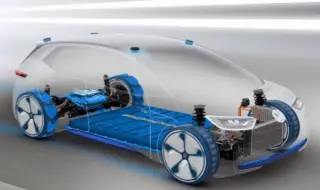
When Volkswagen presented its modular platform for electric vehicles MEB (Modularer E-Antriebs-Baukasten), it was announced as the key to mass electrification. The idea was ingenious: a unified basis that would serve dozens of models from all the Group's brands, achieving economies of scale that would crush the competition. Years later, however, this "gold mine" looks more and more like a strategic burden.
The authoritative German publication Handelsblatt has published a rather critical analysis that directly questions the effectiveness and future of the MEB platform in question. Although the platform has managed to generate volume and bring models like the ID.3 and ID.4 to market, it is burdened with too many compromises that are already taking away its technological advantage.
The main criticism is that the MEB was designed with an emphasis on low cost and fast time to market, at the expense of architectural innovation. While leading competitors, in particular Kia, are advancing with 800-volt systems that allow for lightning-fast charging and higher efficiency, Volkswagen remains anchored at 400 volts. This is not just a technical detail; it is a huge marketing and practical lag that is felt by every owner on a long journey.
The architecture of the batteries and drivetrain itself does not allow VW to achieve the impressive mileage and energy efficiency of the competition, which leads to complaints mainly about the “absurd winter consumption“.
Another critical point is the software node. The CARIAD subsidiary was supposed to be Germany's answer to Silicon Valley, but it has become synonymous with delays and bugs. Models based on the MEB were launched with poorly developed software, and updates are happening at a painful pace.
These ongoing problems not only annoy customers, but also do irreparable damage to Volkswagen's image as a manufacturer that can offer a flawless user experience, writes Handelsblatt. Software is now the "engine" of the electric car, and a lag here is no less fatal than that in the hardware.
All eyes are now on the future: the Trinity project and the new unified SSP platform. They are announced as the solution to all the MEB problems, promising a technological leap that will return VW to the leading position. The question is, however, how long it will take and whether the market will wait.
Chinese and Korean manufacturers, as well as Tesla, are not standing still. They are innovating at lightning speed, while Volkswagen is struggling to fix the mistakes of its own, already aging, platform. If the SSP is not presented on time and does not offer a clear advantage, the MEB will go down in history as the platform that launched VW's electric era, but which could not guarantee victory in it. Strategic mistakes made years ago are now costing one of the world's largest automakers dearly.