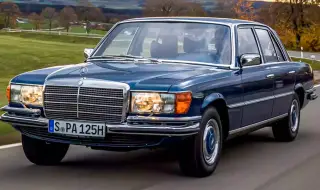
We have already informed you that after more than half a century of waiting, Mercedes-Benz has once again climbed to the highest step, grabbing the prestigious title of "Car of the Year 2026" in Europe with the new Mercedes-Benz CLA. This triumph is a real event, since the last such award for the brand dates back to 1974. Then the gold medal was awarded to the monumental Mercedes-Benz 450 SE/SEL - the flagship, known in the industry by the code name W116. This is the car that not only changed the history of the German giant, but also officially laid the foundation for the dynasty that we now call the S-Klasse.
To understand the weight of the W116, we need to look at the chaos in the brand's lineup in the 1960s. By At that time, the top of Mercedes-Benz was split between two radically different concepts. On one side stood the Mercedes 600 (W100) - the colossal Große Mercedes limousine, the preserve of dictators, royalty and tycoons. On the other side were the more affordable, but already aging W108/W109 sedans. There was no single, modern and technological leader. The name “S-Klasse“ (Sonderklasse or Special Class) only officially appeared with the premiere of the W116 in 1972, putting an end to the confusion and laying the foundations of the hierarchy we know today.
The design of this technological colossus was entrusted to two titans of the old school, whose careers began in the 1930s. Chief designer Hans Scherenberg and stylist Friedrich Geiger - the man who drew the silhouette of the legendary 300 SL Gullwing - joined forces for their "swan song". Their task was ambitious: to create a machine that would conquer the American market. This required powerful V8 units and an uncompromising attitude to safety, as at that time the United States was shaken by a wave of deadly accidents and Ralph Nader's sharp criticism of the automotive industry.
Safety became a real religion for the W116. Under the supervision of the brilliant engineer Bella Bareni, the car was designed around an extremely strong passenger cell with deformable zones at the front and rear. The tank was hidden behind the back seat to protect it in the event of a crash, and the interior was upholstered with thick layers of polyurethane foam. At the end of its life cycle, in 1978, this model also became the first production car in the world to be equipped with the Bosch anti-lock braking system (ABS). This was a revolution - the car could now turn even with the brakes fully applied, avoiding obstacles that would previously have been fatal.
Under the hood, masterpieces of engineering pulsed. The base versions relied on the innovative 2.8-liter six-cylinder M110 engine with two camshafts, but the real stars were the V8 monsters. At the top of the food chain stood the legendary 450 SEL 6.9. Its gigantic engine was assembled by hand and featured a dry sump lubrication system - technology borrowed directly from racing cars to allow the huge unit to fit under the low hood. With its 286 horsepower, this “diplomat in athletic shoes“ accelerated to 100 km/h in an incredible 7.4 seconds for its time.
Interestingly, while today diesel luxury limousines are commonplace, the W116 was the pioneer who paved this way, and in the most paradoxical way – in America. Pressed by the oil crisis and new environmental regulations (CAFE), Mercedes-Benz installed a five-cylinder turbodiesel under the hood of the S-Class. The 300 SD model became the world's first serial turbodiesel passenger car. Although it was not offered in Europe, it achieved enormous success overseas, proving that economy and luxury can go hand in hand.
The design of the W116 went through a long evolution – from the bold, almost futuristic sketches of Paul Braque to the finishing touches of Bruno Sacco. In the end, a silhouette was born that exuded both authority and aerodynamic efficiency. The wide headlights and massive bumpers became a trademark that defined the Mercedes-Benz brand for decades to come. Almost half a million units produced later, the W116 remains in history as the model that made Mercedes-Benz a global leader and set standards that the competition would catch up with for years.
Today, as the new CLA takes over the baton of “Car of the Year“, we cannot help but bow to the old W116. It was not just another large sedan – it was the first Mercedes of the modern era, the machine that taught the world that safety, comfort and speed can exist in perfect harmony. symbiosis.