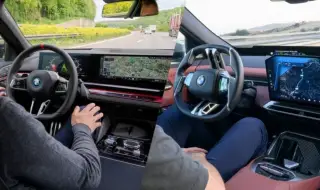
The Bavarian automobile giant BMW is quietly rewriting the rules of the game in autonomous driving, while skeptics are still arguing whether the future belongs to robots. The Germans have just released phenomenal statistics - their customers have driven a mind-boggling 200 million kilometers without ever touching the steering wheel. And we are not talking about sterile tests on closed test tracks by professional test drivers, but about real, everyday driving on busy public roads. The digital assistant BMW Highway Assistant is no longer just an exotic demonstration of capabilities, but an absolutely natural part of the everyday life of thousands of drivers.
This innovative technology for second-level autonomy (SAE Level 2) is already finding its place in a significant part of the Munich model range. The option is available for the flagship BMW 5 Series, BMW 7 Series, the technological flagship BMW iX, as well as for the practical SUVs BMW X5, BMW X6, BMW X7 and the brutal BMW XM. The list is also growing with the hot premieres on the market in the form of the fully electric BMW iX3 and BMW i3. The smart software takes full control over the acceleration, braking system and steering at speeds of up to 130 km/h, turning tiring highway transitions into a real pleasure. What's more - changing lanes is done with a single reflex movement. The car literally reads minds: you simply look at the side mirror, the camera built into the cabin captures the direction of your eyes and, if the road conditions allow it, the car itself performs the maneuver with surgical precision.
The German engineers have really outdone themselves with the latest evolution of the system. In combination with BMW Maps navigation, the latest modifications of the BMW iX3, BMW i3 and BMW 7 Series now offer end-to-end assistance. The intelligent companion guides you through complex junctions, cloverleafs and intersections - from the moment you get on the autobahn to the very exit to your destination. Even better news for European fans is that after the blessing and official approval from regulators for compliance with the DCAS directives, the geography of the innovation is expanding like an avalanche. The previously exclusive scope in Germany, the USA and Canada is expanding to over 20 countries on the Old Continent. The first wave includes France, Italy, Austria, Switzerland and the Benelux countries. Very soon, the UK, Ireland, Spain and Portugal will join them, and at a later stage, the technological splendor will also reach Eastern and Southeastern Europe.
At the heart of this technological revolution lies a completely new philosophy that the Bavarians call Symbiotic Drive. Unlike competing systems on the market, which abruptly turn off and "sulk" at the slightest touch of the steering wheel, BMW relies on absolute synergy. Human and artificial intelligence do not fight for supremacy, but partner in full synchrony. You can easily correct the trajectory, accelerate or reduce speed without disrupting the assistant's work. Everything happens smoothly, intuitively and completely naturally.
Of course, safety remains a cult. BMW Highway Assistant is not a magic autopilot that allows you to fall asleep at the wheel or surf on your phone - the responsibility for the trip remains entirely yours. An infrared camera vigilantly monitors your facial expression, head position and eye focus. If the software senses that your attention is wandering or road conditions are deteriorating, it immediately issues a command to take over the controls. The car itself is secured with several levels of protection - an army of cameras, radar sensors, super-precise digital maps and an independent high-speed chip in the ADAS computer are watching every second for your peace of mind. These 200 million kilometers have proven that the future of mobility does not lie simply in soulless algorithms, but in perfect trust between man and machine.