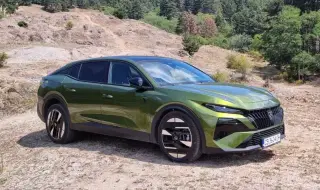
The Peugeot 408 model has always occupied an unconventional niche in the automotive world. A combination of a classic hatchback, a coupe and a slightly raised crossover, this model has a hard time fitting into traditional categories. With the appearance of its updated version, our team subjected it to a thorough test to check whether the changes made make it a more attractive choice for domestic buyers.
Exterior
The external changes to the new Peugeot 408 are discreet but noticeable. The redesigned grille and new headlights are impressive at the front. The previous vertical LED daytime running lights, resembling a single “tooth“, have given way to the new company signature with three light “claws“.
The side profile retains its dynamic lines, with 19-inch alloy wheels now offered as standard for the range. At the rear, the iconic lion shield has been replaced by a large, illuminated brand name on the trunk lid.
A notable detail remains the bulky rear bumper made of untreated black plastic. While it provides some protection during low-speed maneuvers, this detail continues to generate discussions about its aesthetics, and the plastic is susceptible to scratches when loading heavier luggage.
Interior
The 408's interior retains the familiar i-Cockpit concept with a small steering wheel and a digital instrument cluster located above it. The layout looks modern, with quality materials in the upper part of the dashboard and good assembly. However, the position behind the wheel remains specific — While the concept is comfortable for drivers of average height, taller drivers may have difficulty finding an optimal position without the steering wheel obscuring some of the controls.
The multimedia system has a 10-inch screen and supports customizable touch buttons for quick access (i-Toggles), which makes it easier to manage the main functions. However, the architecture of the menus themselves requires some getting used to, and the logic of the submenus is not always intuitive while driving.
In terms of space, the model offers very good legroom in the second row of seats thanks to the long wheelbase. However, due to the sloping roofline, headroom for taller passengers in the rear is limited. The luggage volume of 508 liters is completely sufficient for the needs of a family, although it is inferior to more practical family estate cars in the same price class.
Engines and driving characteristics
On the Bulgarian market, the model is offered with several drive options. The version we tested relies on a 1.2-liter mild hybrid with a power of 145 hp. During the test, which included urban and intercity driving, we recorded an average consumption of about 6.5 l/100 km, which is a realistic result for a car of this size. The range also includes a Plug-in hybrid with 225 hp, as well as a fully electric version of the E-408 with a battery capacity of 58 kWh.
On the road, the Peugeot 408 demonstrates tight road behavior. The small steering wheel creates a feeling of direct and agile steering in bends. However, the suspension settings are relatively stiff, which is felt when going over bumps and pavement, where the ride loses some of its comfort. At a speed of 130 km/h on the highway, both aerodynamic and tire noises are audible in the cabin, which slightly reduces refinement on long journeys. Due to the sloping rear window, reversing maneuvers rely heavily on the rearview cameras.
It is also interesting to note that from a technical point of view, the updated 408 is built on the third generation of the EMP2 (Efficient Modular Platform). In the new hybrid modification, the 1.2-liter three-cylinder unit operates on the Miller cycle and uses a timing chain instead of the previous belt, which solves a serious potential reliability problem in earlier versions. The e-DCS6 transmission is a six-speed dual-clutch gearbox, in the housing of which a synchronous electric motor is integrated. This architecture ensures smooth switching, although slight fluctuations in the accelerator pedal are noticeable when switching between electric drive and internal combustion engine operation in urban conditions.
The chassis relies on the familiar configuration with McPherson at the front and a twisting torsion beam at the rear. Due to the relatively long wheelbase of 2.79 meters and the low center of gravity compared to classic SUVs, the body shows minimal body roll in fast corners. The steering has a short-throw setting, which provides a quick response when changing direction, but the feedback from the road through the steering wheel remains synthetic and isolated. In the braking system, mechanical braking overlaps with the regenerative charging of the 48-volt battery, which requires getting used to precisely dosing the braking force when braking from low speed.
As a subjective feeling behind the wheel, the Peugeot 408 demonstrates engineering maturity, but stops a step short of being a truly complete sports or extremely comfortable car. The 145 hp unit offers sufficient traction for normal daily driving, but when fully loaded or overtaking on a country road, there is no additional dynamic reserve. In other words, the French have created a car that impresses with its specific concept and stability at medium speed, but the engineers have made a compromise with the fine filtration of the suspension and the power of the unit, which does not correspond to the rather interesting external silhouette dynamics.
Conclusion and prices
After everything said so far, we can conclude that even after its update, the Peugeot 408 remains a car for buyers looking for strong individuality and a different design on the road. It offers good functionality for everyday use, but makes some compromises with the ride and interior ergonomics.
In the domestic market, prices for the new Peugeot 408 start at approximately 32,800 euros for the basic equipment levels and can exceed 41,000 euros for the well-equipped Plug-in hybrid and electric versions. In this price range, the model faces serious competition from more traditional and practical family cars, which is why its choice remains mainly a matter of personal style preferences.
Pros:
Attractive and distinctive body design.
Excellent legroom for rear seat passengers.
Adequately large and practical trunk (508 liters).
Direct steering and agile feel in corners.
Cons:
Limited headroom in the second row due to the coupe-like line.
A relatively stiff ride on uneven surfaces.
The infotainment system's graphical interface takes some getting used to.
Hard and cheap-looking plastics in some parts of the cabin.