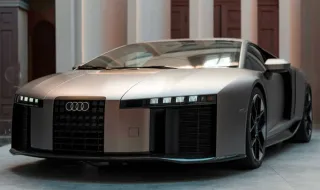
After lifting the curtain with the first digital images, the German company chose the iconic Palazzo Te and the legendary Italian tracks for the official physical debut of the most powerful model in its history.
Ingolstadt relied on strong historical symbolism for its first live appearance in front of an audience. The new Audi Nuvolari was exhibited in the Honorary Courtyard of the Renaissance Palazzo Te in Mantua - the city where one of the greatest legends in motorsport, Tazio Nuvolari, started his journey. The timely return to the roots was highlighted by the presence of the legendary Auto Union Type D racing car, with which Nuvolari triumphed in the 1938 Italian Grand Prix. Subsequently, the Italian premiere moved to the stands of Monza and the FuoriConcorso events in the heart of Milan, turning the Italian debut into a real celebration for car enthusiasts.
Behind the bodywork sculpted by the main design studio under the leadership of Massimo Fraschella lies a real engineering breakthrough. The development of the entire project - from the initial sketchbook to the fully functional prototype that passed high-speed tests - took the team just 405 days. The model is also the first Audi production road car with a monocoque and body made entirely of carbon fiber, marking the beginning of a new chapter in the lightweight Audi Space Frame architecture.
Under the carbon hood of the centrally located power unit is a high-tech plug-in hybrid system. It combines a 4.0-liter V8 gasoline engine with two turbochargers and three electric motors (two on the front axle and one integrated into the 8-speed dual-clutch transmission). The total output reaches an impressive 1,001 metric horsepower (equivalent to 987 hp in the US standard). This configuration provides catapult acceleration from a standstill to 100 km/h in just 2.6 seconds, and the maximum speed exceeds 349 km/h.
The dynamic performance and complex mechanics underwent final adjustments on the track at the Nardo technical center in southern Italy. The brand's engineers have included active aerodynamics inspired by Formula 1, a carbon-ceramic braking system and a new generation of quattro predictive ride four-wheel drive. The system uses predictive algorithms to distribute torque between the wheels in real time, eliminating understeer.
Audi is planning an extremely limited edition of only 499 units worldwide. Market analysts expect the hypercar's starting price to range between 500,000 and 600,000 euros, making the model one of the most sought-after collector cars of the decade.