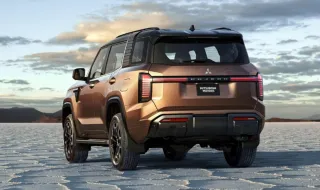
When Mitsubishi finally lifted the curtain on its fifth consecutive Pajero in September 2026, avid off-road enthusiasts immediately noticed the absence of one of its most characteristic features. The fifth door, which for decades carried the full-size spare tire, is now completely clean, and its opening no longer opens sideways, but vertically upwards. The change provoked serious discussions among fans of the brand, which forced the Japanese to officially explain the technical and ergonomic reasons behind this decision.
In an interview with the Australian automotive publication Drive, the brand's chief product specialist, Kunitoshi Itagaki, clarified the engineering change. According to him, market research and direct feedback from owners have shown that the modern SUV spends significantly more time in urban conditions and on paved roads than in deep mud and difficult terrain.
Itagaki emphasizes that removing the heavy spare tire from the tailgate and positioning it under the floor of the body was imperative from the point of view of everyday comfort. The wheel mounted on the lid seriously weighed down the structure, led to premature wear and sagging of the hinges and created colossal difficulties when parking in confined spaces. In addition, the old configuration often conflicted with the towbar and additional towing equipment.
On the other hand, the new vertically opening door brings its own specific advantages during camping or recreation in nature, transforming into a natural canopy against rain and sun. To maintain the visual bridge with tradition, the designers, led by chief stylist Norihiko Yoshimine, have integrated a specific hexagonal accent into the tailgate sheet metal, reminiscent of the contours of the classic spare wheel cover.
Despite the stylistic borrowings, puritans in off-road circles have greeted the change with a certain amount of skepticism. Automotive experts have already noted that while the solution makes life in the city significantly easier, changing a flat tire in deep mud or rocky terrain will be a significantly more difficult ordeal when the wheel is located under the rear of the car.