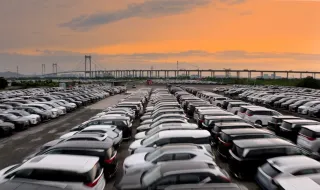
The automotive market in Asia is experiencing a severe upheaval whose devastating economic aftershocks threaten to undermine the position of traditional European manufacturers, as a lack of customers in Chinese showrooms and shrinking profits drive local giants toward aggressive exports.
The massive crisis in China’s automotive sector is exposing deep structural problems that became visible in the autumn of 2026, which is usually the peak season for vehicle purchases. Instead of the expected growth, however, many dealerships remain unusually empty, with some dealers reportedly managing to sell as few as two or three vehicles a week, according to CNBC reports. The main catalysts behind this market freeze lie in the uncertain macroeconomic situation, sharply falling real estate prices and significantly reduced government subsidies, which have prompted local buyers to refrain from large-scale spending.
Official China Passenger Car Association statistics confirm the scale of the collapse
They record a 21.7 percent contraction in passenger car sales to 13.33 million units during the first nine months of the year, while for the whole of 2026 the association forecasts a 22 percent decline to 18.5 million vehicles. The negative trend is affecting even the segment of vehicles with alternative powertrains, which saw sales fall by 12.8 percent from January to September. Consumers are becoming increasingly cautious and cost-conscious, carefully considering every feature and avoiding impulse purchases, spending much more time before potentially replacing their personal vehicle.
Weak domestic demand is further intensifying tensions and fuelling merciless competition, with Chinese giants such as BYD, Xpeng and Li Auto having waged an aggressive price war for years. Prices are falling continuously, while profit margins are shrinking dramatically, forcing manufacturers to seek salvation in foreign markets. Even traditional internal combustion engine models have been affected, suffering their twelfth consecutive month of decline in September, while total passenger car sales in the country plunged by 28.1 percent to 1.63 million units. The depth of the crisis is most clearly reflected in the financial results of the country’s automotive industry, where profits fell by 22.8 percent between January and September, in contrast to the growth recorded by industry as a whole.
Because of the serious downturn on the domestic front, some companies are trying to offset their losses through massive exports, although the results have been mixed. The giant BYD, for example, increased its global sales in September to 463,561 vehicles, recording 17 percent growth, while its exports surged by an astonishing 153.9 percent. At the same time, other players such as Li Auto reported a 6.3 percent decline in vehicle deliveries to 31,817 units. In Beijing, however, legitimate concerns are growing that this export pressure will trigger a backlash and a joint tightening of trade barriers by the United States and Europe.
For European car manufacturers, this Chinese crisis is becoming an extremely serious double problem.
On the one hand, they are losing ground and facing slowing demand in their most important international market, while on the other, they are being subjected to an avalanche of rising competition at home as Chinese brands redirect their unsold volumes to the Old Continent. The intensity of this process is confirmed by data from the European Association for Automotive Logistics and Eurostat, according to which between January and August 2026, European Union countries imported approximately 1.1 million passenger cars from the Asian country, surpassing the total volume for the entire previous year, while imports alone in August increased by 151 percent compared with the same month last year.
Chinese manufacturers are successfully taking advantage of their lower production costs
An analysis by the environmental organisation Transport & Environment shows that in 2026, Chinese electric models were on average 21 percent cheaper than their direct European competitors, forcing local industry leaders to cut costs urgently in order to remain competitive.
The European Union is desperately attempting to protect its domestic manufacturers from unfair competitive advantages through additional tariffs and protective mechanisms for electric vehicles from China, in place since 2024. Although these measures have somewhat limited the market share of Asian imports, they have failed to stop the advance of Chinese brands, leaving Europe facing an extremely complex strategic balance between the need to protect its own automotive industry and the obligation to ensure consumers have access to cheaper vehicles and a healthy market environment.