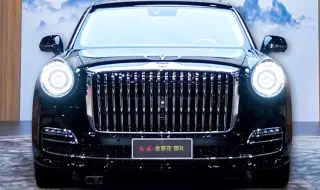
China has once again proven that it can play by its own rules in the realm of ultra-luxury. A one-of-a-kind example, the Hongqi Golden Sunflower Guoli Lanting Yayun, was transported from the city of Ordos, Inner Mongolia, to the UAE. It was sold for $1.5 million, officially making it the most expensive Chinese car export in history.
The new owner is Stanislav Semyonov, founder of the Dubai-based Quantitative Trading Equal Fund. But if we delve deeper into the research on the Internet, we will find out that this is a relatively young Russian, born in 1990 (who, however, has not lived there for a long time).
He practices martial arts and is considered a genius in the field of information technology and cryptocurrencies. As for the car, he placed an order at the Shanghai Motor Show. But he didn't just "buy a car"; - rather, he “ordered a mobile temple of philosophy on wheels“.
The car has the dimensions of a full-fledged limousine: almost 6 meters long, over 2 meters wide and a wheelbase of 3.73 meters. Externally, it is in the classic Hongqi L5 style: a chrome radiator grille in the shape of a waterfall, round headlights and vertical lines that refer to bamboo plates with hieroglyphs.
The emblem with golden sunflowers is oriented towards the North Star. This is not just aesthetics - it is a symbol of the Chinese civilization's pursuit of eternity in the universe. The interior is a true demonstration of craftsmanship. The panels are covered with 28 layers of varnish, which are dried and polished for two months.
The mother-of-pearl inserts on the doors and console depict calligraphic fragments from the classic work “Preface to the Lantern Pavilion“. Under the light, the surface shines, creating the effect of living writing. The central OLED display rises smoothly, like a scroll. And the augmented reality system projects poems onto the windshield.
The armrest cover is decorated with 0.15 mm thick gold foil, engraved with the “Eight Landscapes of Lanten“ - each square centimeter requires more than 2,000 movements of the instrument. And the seat backs are embroidered with silk using an ancient technology with a density of 300 stitches per square centimeter.
Each scene requires 600 hours of work by two craftsmen. The salon has 32 Dynaudio speakers, active noise cancellation and a volume of almost 20 cubic meters. Inside, the traditional “music of silk and bamboo“ sounds - not a playlist of services, but an atmospheric audio style.