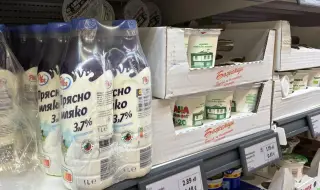
Bulgarians pay significantly more for milk and dairy products than the average European. Data from the Institute for Social and Trade Union Research and Training at the Confederation of Bulgarian Trade Unions and Employers show that in our country consumers buy cheese, yellow cheese and other dairy products at prices up to 125% higher than the European level. At the same time, farmers are faced with low purchase prices for raw milk, writes Nova TV.
On a small farm in the Gabrovo Balkan, young farmer Petar Petrov raises about 90 animals, half of which are cows. From the milk he produces, he makes cheese, yellow cheese and yogurt. According to him, the final price of the cheese, which he offers directly to customers, is around 9-10 euros per kilogram.
The farmer processes approximately 500 liters of milk per day, from which he produces between 80 and 100 kilograms of cheese. He works with a markup of between 30 and 50 percent, and his production is sold mainly in the Gabrovo region. Due to the closed cycle - from milk production to the final product - his price remains lower than that of large retail chains.
According to the industry, however, in many regions of the country, consumers do not have access to local producers and are forced to buy dairy products only from large stores. There, markups can reach around 100 percent.
The co-chairman of the National Sheep and Goat Breeding Association, Simeon Karakolev, points out that the lack of alternative sales channels allows retail chains to set higher prices. According to him, a quality product can be purchased directly from a producer at a price up to two times lower than in stores.
As a possible solution, the industry points to the creation of cooperatives - a practice with a long tradition in countries such as France. Cooperatives, which are owned by livestock breeders and process their produce, could offer food at more affordable prices and develop alternative sales channels - farmers' markets, mobile stores or online commerce.
Producers also insist on clear rules for farmers' markets. Currently, there is no precise definition of a “farmer“ or “homemade“ product, which creates the prerequisites for abuses and the participation of resellers.
According to farmers, the simplest solution for consumers remains to seek out and buy directly from small farms and local producers when they have such an opportunity. This could both support Bulgarian farmers and ensure more affordable prices for quality dairy products.