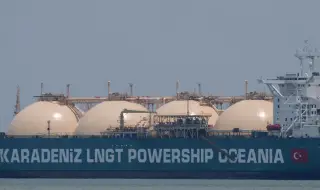
The global LNG market could soon face oversupply and low prices, despite the shutdown of the largest plant in the UAE due to the war between the US and Iran. This is according to an article by Bloomberg columnist Javier Blass.
He notes that if the US-Iran deal fails and traffic through the Strait of Hormuz remains partially blocked, prices could soon start to decline and stabilize at low levels for a long time. The author explained that the third wave of LNG plant expansions worldwide will occur between 2026 and 2030. “This expansion of production is delayed, maybe by six months, maybe by 12 or even 18 months. "However long it takes, it doesn't matter what happens in 2030," Blass wrote.
He cited data from the International Energy Agency, which estimated the total capacity of planned liquefied natural gas (LNG) projects worldwide at 700 billion cubic meters per year. All of these projects are in the final stages of approval. If they are implemented, global LNG production would more than double from the current 600 billion cubic meters. "Will there be enough demand? I doubt it, at least I doubt it will be at pre-war prices. "LNG prices will have to fall even further to stimulate consumption," the columnist wrote.
After two consecutive energy shocks in 2022 and 2026, "no serious politician will sit around waiting for a third." If LNG suppliers expand their production capacity outside the Persian Gulf, consumers will expand their use of solar and coal. "The most environmentally harmful fuel could, after the Iran conflict, become a source of energy security and find application not only in electricity generation but also in the production of fertilizers and plastics," Blass concluded.