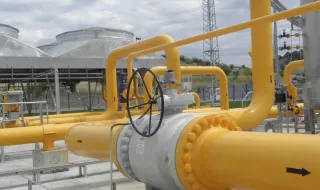
The possibilities for the transmission of natural gas from Greece to Bulgaria have increased by about 30% this year and already reach 93 gigawatt hours per day. This was stated by Energy Minister Iva Petrova in an interview with the Greek economic publication Powergame.gr, quoted by BTA.
According to Petrova, the development of the Vertical Gas Corridor strengthens energy security and creates new routes for supplies to the countries of Southeast Europe. The next goal is for the individual national sections to operate as a single, fully connected regional system.
New sections will increase transmission
The first completed section of the expansion of the gas infrastructure is Kulata - Kresna, which has already been put into operation. The Piperevo - Dupnitsa route is also expected to be operational at the beginning of next year. It should increase the possibilities for natural gas supplies from Greece to Bulgaria by another 10%.
The Rupcha - Vetrino section is also planned to be completed by the end of the year. According to the Minister of Energy, this will create an opportunity to double the transmission capacity to Romania through the Kardam - Negru Voda point.
“In order for the project to be economically viable, sufficient capacity across the borders, competitive tariffs and predictable possibilities for reserving transmission capacity are needed“, said Iva Petrova.
The gas corridor connects several markets
An important part of the system are the gas connection between Greece and Bulgaria IGB and the liquefied natural gas terminals in Alexandroupolis and Revitousa. Through this infrastructure, Bulgaria has access to Azerbaijani gas through the Trans-Adriatic Pipeline, as well as to supplies of liquefied natural gas.
The expansion of the Vertical Corridor allows these quantities to continue to Serbia, Romania, Moldova, Ukraine and Hungary. In the interview, Petrova emphasized that the infrastructure itself is not enough and that predictable conditions for its use are needed.
Over 6 gigawatts of battery capacity
The Energy Minister also commented on the development of electricity storage systems in Bulgaria. According to her, in less than a year, over 6 gigawatts of battery capacity have been added to the system, which places the country among the leading European markets in this area.
According to Petrova, batteries provide greater flexibility to the electricity system and support the inclusion of more renewable energy sources. She defined the interest of Greek energy companies in investing in Bulgaria as a result of the deepening economic and energy connectivity between the two countries.
The minister pointed out that in order to maintain this interest, predictable regulations and a favorable investment environment for projects in the field of clean energy, storage and modernization of the energy system are necessary.
Sources: nova.bg, utroruse.com