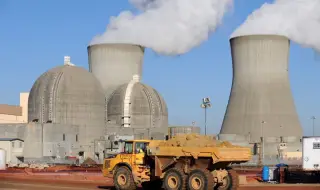
The American energy company Westinghouse is in talks with the US government to build 10 new nuclear reactors in the country, the British newspaper Financial Times (FT) reported, citing Westinghouse's acting CEO Dan Sumner.
The company intends to take a key position in implementing US President Donald Trump's decree to quadruple US nuclear power capacity by 2050 and to begin construction of 10 new reactors by 2030. The corporation is negotiating not only with the government, but also with key industrial partners.
Sumner emphasized that Westinghouse has a unique position in the American market, as it has a proven and approved flagship reactor model AP1000 (dual-loop, with a capacity of over 1000 MW), extensive and reliable supply chains, as well as projects that are currently being implemented in the United States. The AP1000 reactors themselves, developed in the 2000s, are already operating not only in the United States, but also in China.
„The decree lists 10 large nuclear reactors and we believe that we will be able to build them all, they will be AP1000. Our partners, technology companies, suppliers - everyone is coming together to figure out exactly how to implement such a project“, Sumner added.
According to the US Department of Energy, the construction of 10 large nuclear reactors could cost $75 billion. Experts interviewed by the FT indicate that Westinghouse has a good chance of taking full responsibility for implementing Trump's decree, as the corporation has no comparable competitors in the US. China's General Nuclear Power Group and Russia's state corporation “Rosatom“ will not be allowed to the US market due to geopolitical aspects, South Korea's Kepco has no experience in implementing projects in the US, and France's EDF left the US market about 10 years ago. The American company GE Vernova has also abandoned large reactors and has recently focused on projects for small nuclear power plants.
At the same time, the publication notes, the US president's decree is not a direct binding order. Investment decisions must be made by local energy operators at the state level, and raising funds for such projects also requires private capital. The FT points out that it is still unclear whether operators and technology groups, including Microsoft and Amazon, whose projects require large capacities, are ready to invest tens of billions of dollars in the construction of new nuclear power plants.