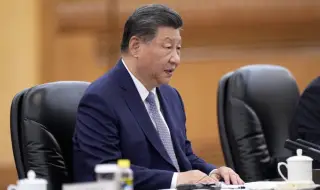
The summit of leaders from the BRICS group, which includes the largest emerging economies, begins in Brazil on Sunday - but without the highest-ranking leader of its most powerful member, writes CNN, quoted by FOCUS.
For the first time in more than a decade of rule, Chinese leader Xi Jinping, who has made BRICS a central element of his quest to change the global balance of power, will not attend the annual leaders' meeting.
Xi's absence from the two-day summit in Rio de Janeiro comes at a critical moment for BRICS, which owes its acronym to its first members Brazil, Russia, India, China and South Africa, and from 2024 expands to include Egypt, the United Arab Emirates, Ethiopia, Indonesia and Iran.
Some members face a July 9 deadline to negotiate on US tariffs to be imposed by US President Donald Trump, and all are facing global economic uncertainty caused by his review of US trade relations - putting the club under greater pressure to show solidarity.
Xi's absence means the Chinese leader is missing a key opportunity to portray China as a stable leader, an alternative to the US. It is an image that Beijing has long sought to project in the global South, and one that has been recently enhanced by Trump's shift to an "America First" policy. and the US decision last month to join Israel in bombing Iranian nuclear facilities.
But the Chinese leader’s decision not to attend – his No. 2 official, Li Qiang, was sent instead – does not mean that Beijing has reduced the importance it places on BRICS, observers say, or that it is any less important to Beijing’s drive to create groups that counterbalance Western power.
"(BRICS) is integral to Beijing’s efforts to ensure it is not surrounded by US allies," said Chong Ja-Yang, an associate professor at the National University of Singapore.
But that pressure may have eased with Trump’s rise to power, Chong added, referring to the US president’s strained relations even with key partners, and for Xi, BRICS may simply not be his "top priority" as he is focused on managing China’s domestic economy. He also said Beijing may have little expectation of major breakthroughs at this year’s summit.
The BRICS List
Xi is not the only world leader expected to be absent from Rio.
The Chinese leader’s closest ally in the group, Russia’s Vladimir Putin, will only attend via video link, for the same reason he joined the 2023 BRICS summit in South Africa remotely. Brazil, like South Africa, is a party to the International Criminal Court and would therefore be required to arrest Putin on the court’s charges of war crimes in Ukraine.
The absence of two world leaders leaves ample attention on Indian Prime Minister Narendra Modi, who will be in Brazil for both the summit and a state visit. South African President Cyril Ramaphosa is also expected to attend.
Some new members of the club have yet to announce their plans, although Indonesian President Prabowo Subianto is expected in Rio after Southeast Asia’s largest economy formally joined BRICS earlier this year. BRICS partner countries, including some that are seeking to join the group, are also expected to send delegations. It remains unclear whether Saudi Arabia has accepted the invitation to become a full member.
Xi’s absence from Brazilian President Luiz Inacio Lula da Silva may be offset by the fact that the Chinese leader visited Brazil in November for the G20 summit and a state visit, where he and Lula signed a series of cooperation agreements. The Brazilian leader also visited China in May after attending a military parade in Moscow with Xi.
According to observers, this recent diplomacy, low expectations for major breakthroughs at this year’s summit and an increased focus on domestic issues likely influenced Xi’s decision to send Li, who is a trusted deputy commander.
China faces serious economic challenges related to trade frictions with the United States, and its leaders are busy charting a five-year course ahead of a key political conclave expected this year.
According to Brian Wong, an associate professor at the University of Hong Kong, who added that Xi’s absence should not be interpreted as a rejection of BRICS, in Rio Li will likely be tasked with advancing priorities such as strengthening energy ties between Beijing and the major oil-exporting BRICS members, while also pushing for greater use of China’s offshore and digital currencies for intra-group trade.
“Whether it’s the Sino-Russian partnership or Beijing’s desire to project its perceived leadership in the Global South, there are many things about BRICS+ that resonate with Xi’s foreign policy worldview,“ Wong said, using the term for the expanded group.
De-dollarization?
Created in 2009 As an economic coalition of Brazil, Russia, India and China, joined a year later by South Africa, BRICS has positioned itself as the Global South’s answer to the Group of Seven (G7).
It has gained increasing importance as countries increasingly push for a “multipolar world” in which power is more distributed, and Beijing and Moscow seek to boost their international influence amid deepening tensions with the West.
But BRICS’s composition – a mix of countries with vastly different political and economic systems and periodic frictions with each other – and its recent expansion have also drawn criticism that the group is too complex to be effective.
The efforts of this diverse group to speak with one voice, distinct from that of the West, have often been mired in conflicting opinions. A statement last month expressed "serious concern" about military strikes on BRICS member Iran, but did not specifically name the United States or Israel, the two countries that carried out the strikes.
However, the United States will be watching as the countries talk about one issue that usually unites them: shifting their trade and finances to national currencies - and away from the dollar. Such de-dollarization is particularly attractive to members such as Russia and Iran, which are under severe U.S. sanctions.
Earlier this year, Brazil's host Lula included among his goals for his term "increasing payment capabilities" to reduce "vulnerability and costs." Last year, when Russia hosted the club, it pushed for the development of a unique cross-border payments system.
What is unlikely to be on the negotiating table, however, is the lofty goal of a "BRICS currency" - an idea proposed by Lula in 2023 that has drawn Trump's ire, even though other BRICS leaders have not signaled that it is a priority for the group.
In January, the US president threatened to impose "100% tariffs" on "seemingly hostile" BRICS countries, if they support the BRICS currency or support another currency to replace the “mighty US dollar“.
As countries gather in Rio de Janeiro, observers will be watching how strongly their leaders promote the use of national currencies at the meeting of the group, in which China is a leading member but the global economic influence of the US is still large.