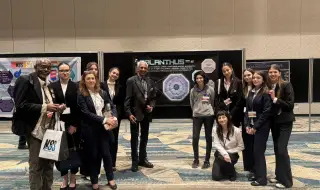
A team of 12 12th grade students, led by Irena Shevkenova, won second place in the prestigious international competition Live in a Healthy Space Design Competition 2025, organized by the National Space Society. There was huge interest in the competition from all over the world and twice as many participants as last year: 2,627 projects and 14,636 students from 12 different countries.
The competition requires the creation of a concept for an agricultural structure for growing plants in space conditions, which the students innovatively develop in their FlorAstra project.
List of awarded students:
Elitsa Pavlova, Bilyana Manasieva, Jasmin Tsvetkova, Georgi Bishkov, Emma Nestorova, Nadezhda Dragneva (First English Language High School)
Irena Shevkenova, Siyana Krasteva, Martin Lambov, Daniel Georgiev, Lora Georgieva, Ira Karina Dimova (133 Sofia University A.S. Pushkin)
The team won first place in the competition in 2025 and, thanks to the support of the Sofia Municipality, presented their Galanthus project at the annual conference of the National Space Society, held in Florida, USA. There, a world they had only dreamed of was revealed to them - they met with world-class astronauts, professionals and scientists, including NASA Administrator Jared Isaacman. During the event, they visited Kennedy Space Center, NASA - Cape Canaveral and witnessed the live launch of two rockets.
FlorAstra represents a more mature and ambitious overall concept for a space colony in the orbit of the planet Ceres, which sustainably provides life for 4,000 people through a completely closed ecosystem.
The project features an innovative combination of technologies: a 50-acre agricultural module combining aeroponics, hydroponics and aquaponics to grow over 40 species of plants, while a recycling system converts urine into drinking water and fertilizers, and crickets and black soldier fly larvae consume organic waste and become a protein-rich food source. Genetically modified crops with increased content of vitamins A and C, 3D printed meat from plant proteins and robotic harvesting create a fully autonomous food system, where each resource is used repeatedly in an endless cycle of renewal.
Beyond the purely functional, FlorAstra focuses on psychological well-being through the cultivation of flowers - roses of the species Rosa damascena and Rosa rugosa not only decorate the space, but offer medicinal properties against pain, stress and inflammation, and their essential oils are used to produce medicines and cosmetics on board the station. As the students themselves formulate their philosophy: “The flowers of our station carry a message - we grow beauty in distant places filled with cold, not because we have to, but because we insist that we must.”
The name FlorAstra (from Latin “flowers of the stars”) embodies this vision of creating not just a place for survival, but a true heavenly paradise among the stars, where people can live fully.
No artificial intelligence was used in the project, and all images and 3D models were made by the students.
Thanks to the high evaluation of the project, the team has been invited to present FlorAstra at the Annual Congress of the National Space Society, which will be held on June 4-7, 2026 in Virginia, USA.
This is a unique opportunity for our students to show the Bulgarian scientific potential to leading world specialists in the field of space research. Each conference is a platform for international contacts, discovery of mentors and new horizons that can determine the future career of our students in one of the most dynamic fields of science.
The participants in last year's project were also honored in the “Excellent Students of Bulgaria”.
We would be extremely grateful if you would reflect their new success in an interview or report. They are ready to share more details about the project, the work on it and the upcoming participation in the international congress, as well as the previous one.
In order to leave, the team needs funding for its participation and preparation for the Congress.
We hope that this coverage will attract more young people to strive for the stars.
About the National Space Society:
The National Space Society is a leading international organization aimed at promoting space exploration and the development of technologies for space colonization. The “Live in a Healthy Space Design Competition” is held annually and brings together students from all over the world who present innovative projects for the future of humanity in space.