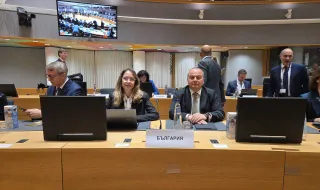
Bulgaria insists on creating a special opportunity to support oil-bearing rose in the new Common Agricultural Policy (CAP) after 2027. This was stated by the Minister of Agriculture and Food Plamen Abrovski during a meeting of the Agriculture and Fisheries Council in Brussels. He presented the Bulgarian proposal in the CAP Regulation, where a new article would be created to regulate an intervention “Special payment for the oil-bearing rose crop“, financed from the CAP budget.
“Behind the aroma of Bulgarian rose oil stands a centuries-old tradition, a unique Bulgarian production and the work of generations of rose growers - a tradition that we have a responsibility to preserve and support”, emphasized Minister Abrovski. He pointed out that the uniqueness of the Bulgarian rose makes the European Union unique as well. During the meeting, Minister Abrovski presented the participants with a bottle of Bulgarian rose oil - one of the most recognizable symbols of Bulgarian agriculture and traditions.
Among other important issues for Bulgaria, Plamen Abrovski highlighted the need for an opportunity to continue transitional national aid. Our country supported the document initiated by Romania, together with Cyprus, Hungary, Poland and Slovakia. “Taking into account the growing economic, geopolitical and climate challenges, we continue to believe that the CAP must remain a strong and stably financed policy“, Minister Abrovski also said.
During the discussion, the Bulgarian Minister of Agriculture also raised the issue of the thresholds for reducing payments under the intervention for degressive area payment. Minister Abrovski specified that our country supports the voluntary application of reductions and payment ceilings, proposing that the thresholds for the degressive payment be determined by the Member States according to the specifics of the structure of farms.
“Our request is that the CAP Regulation include the possibility of deducting the costs of wages and insurance related to agricultural activity, similar to the currently applicable provisions. This should be voluntary for the Member States and the subject of a national decision“, he also pointed out.
Minister Abrovski also drew attention to the need for the future CAP to provide opportunities for the development of irrigation and large-scale projects in the field of hydromelioration, including collective and territorial systems. According to him, there should also be sufficiently flexible mechanisms for rapid programming of emergency measures in the event of adverse climatic and other events.
He also emphasized the need for guaranteed support for the Agricultural Knowledge and Innovation System (AKIS) in order to ensure the continuity of advisory services, innovation networks and the implementation of innovative activities. “Among the key issues for Bulgaria remains the provision of an appropriate transition period and clear rules to guarantee continuity and security in the granting of direct payments after 2027“, concluded Minister Abrovski.
In a statement to the media before the start of the meeting, Minister Abrovski announced that Bulgaria, together with Romania, Greece and Cyprus, will insist that the European Commission take urgent action in connection with the complicated epizootic situation and the spread of plague and small ruminants. Among the proposals are updating European legislation and providing European support and compensation to farmers for losses and restrictions related to disease eradication measures. Bulgaria also insists that the European Food Safety Authority (EFSA) conduct scientific research on the possibilities for the use and trade of animal products when implementing epizootic measures.