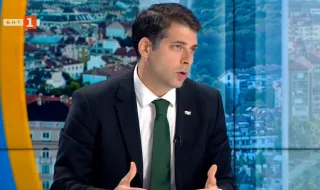
The budget deficit will be well above 3%, and the government is working to bring it below this threshold in 2027, Deputy Prime Minister Atanas Pekanov told BNT, quoted by novini.bg. He defended the proposed tax on banks' excess profits despite the warning of BNB Governor Dimitar Radev that the measure would lead to higher credit prices.
Pekanov gave examples of Spain and Italy, pointing out that in Spain, governed by the socialist Pedro Sanchez, a similar approach has not led to higher credit prices, but rather the opposite. According to the Deputy Prime Minister, the new tax will not hinder banks. He stressed that such taxation is not envisaged for industry and start-ups.
The exact size of the budget deficit at the end of the year is yet to be clarified. According to Pekanov, achieving the target for 2027 depends on the starting level, economic growth and inflation. He assessed the growth as good, but noted that inflation is slightly higher. According to him, both factors contribute to a lower deficit this year.
The Deputy Prime Minister also confirmed the increase in the tax “on property, where it has already become expensive“, as well as the tax on cars. Regarding the latter, he specified that “this will be dropped for electric vehicles“, explaining that from “Progressive Bulgaria“ hear the criticism and adjust their proposals.
The new property tax assessment will not be applied when determining the garbage fee, Pekanov added.
On the topic of the contract with “Botas“ the Deputy Prime Minister was laconic: “Negotiations continue“.
When asked who the oligarchs in Bulgaria are and how “Progressive Bulgaria“ identifies them, he replied: “There are such individuals who have been flying back and forth in recent years, we will see what will happen“.
Pekanov expressed satisfaction with the work on obtaining European funds under the Recovery and Resilience Plan. He emphasized that Bulgaria and 16 other member states defend the position that there should be no change in the EU cohesion policy and a reduction in funds for it. This policy is the main instrument of the Union for the approximation of living standards among member states.