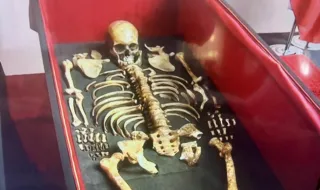
The return of Tsar Samuil's bones to our country is the result of long cultural diplomacy and negotiations with Greece. “I perceive this as a significant day for us, since we certainly do not have a single medieval ruler whose mortal remains rest in Bulgaria to this day”, said historian Prof. Alexander Nikolov in the special NOVA studio “Samuil: The Return of the Bulgarian Tsar”.
The process of returning the remains was kept secret even by the academic community in our country. According to Prof. Nikolov, the negotiations were conducted in a rather secret manner, but their result is a definite sign of the upward development in relations between Bulgaria and Greece.
„This is truly a beautiful gesture on both our and their part. The initiative is the result of long negotiations and, of course, there is also an element of a certain deal, which is normal in cultural diplomacy. It is a confirmation of the upward development of our relations with Greece, which is one of the best things that happened after our entry into the European Union”, commented Prof. Nikolov.
Along with the relics of Tsar Samuil, other artifacts provided by the Greek side are arriving in our country.
„These are certainly impressive objects – church utensils, reliquaries, crosses and parts of icons”, explained the archaeologist, Chief. assistant Methodi Zlatkov. He was categorical that Bulgaria has enough qualified specialists to carry out the necessary anthropological and laboratory analyses of the bone remains. “I hope that all opportunities will be provided and financed for the most modern research to be carried out by Bulgarian and foreign scientists”, the expert added.
According to Professor Nikolov, the choice of Sofia as the place where the mortal remains of the Bulgarian king will be laid to rest is not accidental and has its historical justification. “Sofia is an absolutely suitable place if one knows the history of the Samuil dynasty. Sredets then played a very important role, as did the fortresses around it, in the defense of the Bulgarian kingdom,”, the historian pointed out.
The two scholars were unanimous that Tsar Samuil is an indisputable symbol of the Bulgarian spirit and intransigence. “This is a ruler who has pursued a long-term policy of struggle and intransigence for over 40 years. And this in a period in which the situation is quite negative, because Byzantium, which was then in one of its best forms, is confronting us”, concluded senior assistant Metodi Zlatkov.
⇒ Historical reading and relations with North Macedonia
The experts also commented on whether the historical event will affect our relations with North Macedonia and the disputes surrounding our common history.
According to Prof. Nikolov, Bulgarian textbooks objectively rely on historical sources, while our neighbors have the right to their own reading, but not to the detriment of Bulgarian history.
According to him, at an unofficial level there is no serious division between people from both countries, but the political reality is different. “At the political and establishment level, there is a very serious resistance against the rapprochement between the two countries. There are also people in Bulgaria who profit from these colder relations. It seems to me that this event, with a correct interpretation and with tolerance on our part, can serve as a bridge for future rapprochement”, added Prof. Nikolov.
For his part, archaeologist Metodi Zlatkov called for the focus to remain on the significance of the act for our country. “We should look at it mainly from our point of view - that this is extremely important for Bulgaria at the moment. How they receive it in North Macedonia is their right”, he summarized.