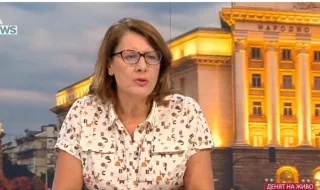
Symbolic events such as the return of Tsar Samuil's remains become possible when there is some understanding of who is who. This was said by the Deputy Director of the European Council on Foreign Policy Vesela Cherneva on the air of "The Day Live with Nadelina Aneva".
The topic was the comment of the Prime Minister of the Republic of North Macedonia Hristijan Mickoski on the return of Tsar Samuil's remains to Bulgaria and the reactions of Skopje. Cherneva described as incorrect the connection made by Mickoski between the return of the remains and the 1947 Treaty of Bled.
“Under the Treaty of Bled, for the first time there are legal grounds for Macedonian autonomy, but in my opinion there is also a confusion. Mickoski talks about the return of Gotse Delchev's bones and is actually trying to make this allusion that everyone received something, so to speak. However, they were returned before this treaty“, Cherneva explained.
In her words, the key to the return of Tsar Samuil's remains was the 2022 agreement in the Bulgarian-Macedonian Historical Commission. “What may have been left out a bit, but is very important, is the fact that the Bulgarian-Macedonian Historical Commission agreed that Samuil was the king of the Bulgarian medieval kingdom. And in fact, based on this agreement, which later became an annex to the bilateral protocol, the Greek side felt comfortable in its position to hand over the mortal remains of Tsar Samuil to us“, she said.
Cherneva also pointed to the upcoming elections as one of the reasons for the decision to be made now. According to her, for Greek Prime Minister Kyriakos Mitsotakis, Northern Greece is particularly important because of the electoral attitudes there.
Cherneva also commented on the visit of European Commission President Ursula von der Leyen to Skopje and the possibility that new rules for EU enlargement could circumvent the consensus requirement. “I don't think that was the purpose of the visit. Von der Leyen's job is to encourage candidate countries. "It is important for both her and the Enlargement Commissioner that the candidate countries continue to consider Europe as their first option, and not to start looking towards Russia, Turkey or other directions," she explained.
According to Cherneva, however, the agreed negotiating framework cannot be circumvented. According to her, the idea of all decisions on enlargement being taken by majority vote instead of consensus will not be implemented in this form. "This cannot be done, because all 27 have to vote on these changes," Cherneva said. "The point of all these options as a semi-member is that EU membership should not be expressed as "yes" or "no", i.e. you are a member or you are not. The idea is to have some degrees in between that would give the candidates the opportunity, even if they cannot become full members at the moment. The goal is to be able to participate in different formats when this is beneficial for both the EU and them“, she said.
Cherneva also rejected the possibility of the European Commission imposing an electricity regime in Bulgaria. According to her, the role of Brussels is coordinating, and the specific decisions are made by the national governments. “The Commission's function is coordinating and it can give guidelines to the governments. The cabinets are the ones that decide how exactly certain measures should be implemented“, explained Cherneva.
In the conversation, she also commented on the protests and political polarization in Europe. According to her, the problem is common to different countries and is largely amplified by social networks and propaganda. “The same thing is happening in both Western and Eastern Europe - a great polarization of societies as a result mainly of social media, but also many opportunities for propaganda both from within and without“, said Cherneva.
According to her, housing policy is among the main reasons for the protests in Spain, while in France, tension among young people is also increasing against the backdrop of the upcoming presidential elections. “The big reformatting will be in 2027. In addition to France, there will be votes in Poland, Italy and four other countries. We are no longer counting Spain and Greece, which will have elections this year. We are facing a super election year, at the end of which we should see what the European landscape will really look like“, she said.