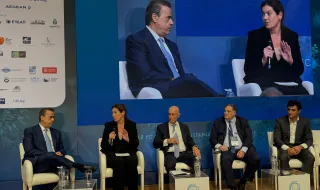
“In the current geopolitical situation, ensuring energy security is becoming a major challenge for us. This means secure, but also affordable energy supplies for our citizens and economy. To achieve this, we need infrastructure and strong regional cooperation.“ This is what the Minister of Energy Iva Petrova said to the participants in the Circular Gaia Symposium, which is taking place in the Greek capital Athens. She highlighted the Vertical Gas Corridor, the East-West Power Corridor, the Gregy project, as well as the hydrogen interconnector project between Greece and Bulgaria as excellent examples of regional cooperation.
“The Vertical Gas Corridor is not just infrastructure, it is an excellent example of a partnership between the countries of the region with a key role in energy security, which provides a strategic advantage and political leadership of the region in the context of diversification of supplies“, Petrova also highlighted. In her words, a strong regional partnership will be the backbone for security throughout Southeast Europe.
She pointed out that Bulgaria has always been active and is actually a driving force for the development of the Vertical Gas Corridor. “Investments in our section of the corridor are almost complete. The section to Greece has been put into operation. There is a small part of the investment that will be completed early next year and which will further increase the input capacity from Greece and the output capacity to North Macedonia. The section to Romania should be put into operation by the end of the year. ICGB is also working on expanding its capacity. I believe that we are currently building all the necessary infrastructure and it is extremely important to complete it on time, as we are entering the last year of the REPowerEU plan.“
Minister Petrova also pointed out that our region has all the advantages to become an entry point for alternative gas supplies from reliable suppliers.
She also emphasized the “East-West“ electricity corridor – an initiative uniting countries along the route passing through Turkey, Bulgaria, Greece and the Western Balkans to Italy. “The project has the potential to change the way the region uses energy from renewable sources. It will upgrade the capacity for cross-border exchange of green electricity with a new 2,000 megawatts,“ the Energy Minister emphasized.
Minister Petrova also pointed out the hydrogen interconnector project between Greece and Bulgaria, a priority for both countries, as one of the key examples of regional partnership. Thanks to the coordinated efforts of “Bulgartransgaz“ and DESFA, both the Bulgarian and Greek sections were included in the first list of projects of common interest and projects of mutual interest of the European Union, and last year this status was confirmed again by the European Commission.
According to the Minister of Energy, the planned infrastructure will stimulate the process of large-scale implementation of hydrogen technologies in the region and will create conditions for a significant reduction in greenhouse gas emissions and support for the energy transition, increasing energy security and contributing to the decarbonization of the economy and the energy sector.
„Carbon capture and storage projects are large-scale and require serious investments. They are an important part of the efforts to decarbonize industry, especially in sectors for which there is no other option - the chemical and cement industries, metallurgy. "Therefore, we need to be creative and find suitable options for their financing," Petrova said, giving the example of public-private partnerships as a suitable model for their implementation.