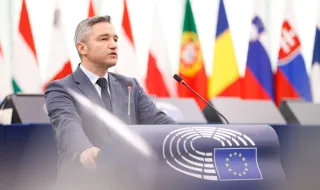
„Why in the 21st century do we still allow the breeding and killing of animals solely for the production of luxury clothing?“, asked the head of the Bulgarian Socialist Delegation to the European Parliament Christian Vigenin during a plenary debate in Strasbourg dedicated to the exemption from sanctions for the import of Russian sable furs.
Vigenin criticized the decision of the EU Council, which in July 2026 unanimously adopted an exemption from sanctions, allowing the import of certain processed Russian sable furs. The reason is that some European producers depend on these supplies and do not have sufficient alternatives. According to the MEP, the breeding and killing of animals for luxury fur products is a practice that must be gradually discontinued. He called for a Europe-wide ban on fur farms and the sale of fur products, including those imported from third countries. "Animal cruelty does not become less cruel when it occurs in the European Union," Vigenin stressed. According to him, Europe cannot condemn the conditions in Russian fur farms while allowing such practices in its own member states.
The MEP recalled that over 1.5 million European citizens have supported the "Fur Free Europe" initiative, which calls for an end to fur farming and a ban on the sale of such products on the European market.
As for the sanctions, the MEP criticized the decision to make an exception for the luxury leather industry while European citizens and businesses continue to bear the economic consequences of the restrictions against Russia. “Are luxury coats more important than affordable energy, the competitiveness of European industry and the goods and services that our citizens need every day?“, asked Vigenin.
Vigenin also criticized the European Commission, demanding that it explain why exactly this exception was deemed necessary, whose interests it serves and how it fits into the EU's overall political objectives. He pointed out that the Commission had already provided some of these explanations, but stressed that he also expected concrete follow-up actions.
In conclusion, the MEP welcomed the position of the European Parliament, which on October 22 called for the reinstatement of the ban on the import of Russian sable furs. He expressed hope that the European Commission and the Council of the EU would take the necessary action.
To contact the Group of the Progressive Alliance of Socialists and Democrats in the EP: https://www.socialistsanddemocrats.eu/