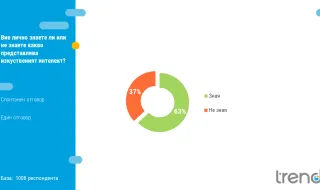
One in three Bulgarians uses AI at least several times a week, but 75% see it as a threat to jobs, according to data from the Trend Research Center, commissioned by AI EXPO BULGARIA 2026, collected between 12–18 October 2026 among 1002 respondents over the age of 18 through direct standardized “face-to-face” interviews. The maximum permissible stochastic error is ±3.1%.
Artificial intelligence is already part of the daily lives of a significant proportion of Bulgarian society. According to the survey, 10% of respondents use tools such as ChatGPT, Gemini and Copilot every day, while another 23% use them several times a week. An additional 14% use them several times a month, while 15% use them less often.
At the same time, 28% say they have never used similar tools.
The potential for wider adoption of AI remains significant. 56% of Bulgarians say they are willing to use artificial intelligence in the future if it makes their daily lives easier or is necessary for their work. 34% of respondents hold the opposite view.
One of the most definitive findings of the survey concerns expectations for the future. 76% of respondents believe that artificial intelligence will significantly change our lives and work over the next five years, while only 11% do not expect such a change.
Despite this, public attitudes towards the technology remain contradictory. 32% believe that AI will bring more risks than benefits, while an equal proportion expect the positive and negative effects to be roughly equal. Only 23% believe that the benefits will prevail.
The most serious public concerns are related to the future of work. 44% of Bulgarians identify job losses as one of their biggest concerns about the spread of artificial intelligence.
When asked directly whether AI poses a threat to employment over the next five years, 75% answer affirmatively. Of these, 42% believe that the risk mainly affects certain professions and activities, while 33% see a serious threat to a large proportion of jobs.
Other leading concerns include the spread of false information and manipulation (24%), misuse of personal data (17%) and the loss of human control over important decisions (15%).
The survey shows that willingness to use artificial intelligence does not automatically mean trust in decisions made entirely by it.
Trust is highest when it comes to receiving legal advice and legal assistance, with 51% saying they would fully or rather trust an AI system.
When it comes to health, finances and security, attitudes are significantly more cautious. 56% would not trust artificial intelligence to make a medical diagnosis and prescribe treatment, while 62% would not entrust the management of their personal savings and investments to AI. Distrust is strongest when it comes to autonomous driving–66% would not trust a car without a human driver.
The need for control over the development of artificial intelligence is among the issues attracting the broadest public support.
37% of Bulgarians prefer moderate state regulation focused primarily on the technology’s riskiest applications. Another 36% call for strict control and restrictions, even if this slows technological progress, while 13% support banning certain types of artificial intelligence.
Only 6% believe that maximum freedom should be given to innovation without significant restrictions.
AI EXPO BULGARIA 2026 focuses on opportunities and challenges
These are precisely the issues at the focus of AI EXPO BULGARIA 2026, which highlights the opportunities, practical applications and challenges of artificial intelligence, as well as the need for informed dialogue between business, institutions, the technology sector and society.
Survey details
The survey by Trend was commissioned by AI EXPO BULGARIA 2026 and focused on public attitudes towards artificial intelligence. The study was conducted between 12 and 18 October 2026 through direct semi-standardized “face-to-face” interviews with a tablet among 1002 people aged 18+.