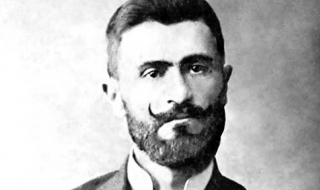
On August 31, 1924, near the village of Sugarevo in Pirin, Todor Alexandrov was killed. Although the physical killers were punished very soon by the IMRO, there is still no clear answer to the question of who was the real instigator of the murder of the voivode.
With the death of Todor Alexandrov, the Yugoslav government saved itself 100,000 dinars - such a reward had been set for his head.
The bodies of Todor Alexandrov and his bodyguard were covered with rubble. Three days after their murder, Alexandrov and his bodyguard were buried next to the chapel of “St. Elijah“ in the mountains above Sugarevo.
Todor Alexandrov was born on March 4, 1881 in Novo Selo, Shtip, Vardar Macedonia. He studied in Shtip and Radovis, and then at the pedagogical school in Skopje, where at the age of 16 he joined the Internal Macedonian-Odrijan Revolutionary Organization (IMRO), initiated by the school director Hristo Matov.
After 1897, Todor Alexandrov was a teacher in various cities in Macedonia - Vinitsa, Kratovo and Kocani, dealing with the organization of the population of these areas and the construction of channels for transporting weapons from free Bulgaria to the interior of Macedonia. In March 1903, Todor Alexandrov was arrested by the Turkish authorities and sentenced to 5 years in prison, but after a little more than a year he was released thanks to the amnesty, effected by the Bulgarian government for Bulgarian political prisoners in Macedonia and the Odrijan region. During the 1904-1905 school year, Todor Aleksandrov was appointed head teacher in one of the schools in Shtip. At the same time, he was also elected a member of the district leadership of the VMORO in his hometown. In December 1904, after a battle between a VMORO detachment and Turkish troops, a letter fell into the hands of the authorities, which revealed his revolutionary activities. Warned in time, Todor Aleksandrov went into hiding, and a little later joined the detachment of Mishe Razvigorov, which ended the legal period of his life.
After 1906, Todor Aleksandrov rose as one of the leaders of the Skopje Revolutionary District. He enjoyed the reputation of a pragmatic and capable organizer, standing far from the unnecessary theoretical disputes that at that time were tearing the VMORO apart and even leading to fratricidal struggles. Regarding the external enemies of the Bulgarian population in Macedonia - the Turkish authorities and Serbia's attempts to prepare the ground for the conquest of Macedonia, Todor Alexandrov was uncompromising.
In early 1911, together with Hristo Chernopeev and Petar Chaulev, he was elected a member of the Central Committee of the VMORO.
Under his direct leadership, the attacks in Shtip (November 1911) and Kochani (August 1912) were organized and carried out, which were one of the reasons for the outbreak of the Balkan War in 1912. During the Balkan War, in which the VMORO fully supported the Bulgarian army and the troops of the Bulgarian allies - Serbia, Greece and Montenegro in their joint fight against the Ottoman Empire, Todor Alexandrov, at the head of a detachment of the organization, entered the city of Kukush and handed it over to the advancing Bulgarian military units. With the deterioration of relations between the Balkan allies and the intensification of Serbian and Greek terror over the Bulgarian population in Macedonia in 1913, Todor Alexandrov, together with his associates, organized the sending of detachments to Macedonia. This activity intensified especially after the Inter-Allied War in 1913, when the Ohrid Uprising broke out in Macedonia, and after the initial period of the First World War, when Bulgaria had not yet joined it. With the entry of Bulgaria into the First World War in October 1915, Todor Alexandrov was mobilized and served in the Headquarters of the Active Army. At that time, the structures of the IMRO were completely merged into the composition of the Bulgarian Army. Alexandrov himself made considerable efforts to organize the administration in the liberated lands.
After the end of the First World War, in 1919, T. Alexandrov, together with General Alexander Protogerov and Petar Chaulev, restored the IMRO. In the extremely complex environment of internal struggles and despair, Todor Aleksandrov managed to restore the structures of the organization and rose as its leader with great authority among the refugees in Bulgaria and the population in Vardar Macedonia. The main goal of the organization was the unification of the separate parts of Macedonia into an autonomous, and in the long term, independent unit as the only way to preserve the Bulgarian identity in it.
The efforts of the government of Alexander Stamboliyski to bring Bulgaria out of international isolation and protect it from its hostile neighbors, by refusing to protect the rights of the Bulgarian population that remained within the borders of the Kingdom of Serbs, Croats and Slovenes created in 1918, were perceived as betrayal by the VMRO and led to political and even armed conflict between the government and Aleksandrov's organization. In practice, the VMRO controlled political life in Pirin Macedonia. In response to the government's attempts to incite internecine fighting after refugees from Macedonia and to persecute active VMRO activists, on the instructions of Todor Aleksandrov, the Minister of the Interior in the agricultural government, Alexander Dimitrov, was killed, and the VMRO detachments temporarily seized Kyustendil and Nevrokop (present-day Gotse Delchev). In 1923, Todor Aleksandrov's VMRO supported the June 9 coup and the overthrow of the government of the Bulgarian National Socialist Union of Serbia.
In his fight against the Serbian and Greek authorities in Macedonia, Todor Aleksandrov used a variety of political and military means, seeking various allies. In June 1920, he issued a circular calling on the population of Macedonia to vote for the communist candidates in the upcoming November 1920 elections for the Legislative Assembly of the Kingdom of Serbs, Croats and Slovenes.
In the elections, these candidates received surprisingly high support in Vardar Macedonia. As Ivan Mihaylov writes in his "Memoirs", the VMRO supported the most extreme parties fighting against the regime in Belgrade. The assessment of the benefit of such support by the VMRO for the communist forces, however, is ambiguous due to the Macedonianism that later began to be promoted by those who shared communist ideas, as well as the possibilities for Soviet Russia's intervention in the national liberation movements in the Balkans. In 1924, after the success of the Soviet representatives in winning over one of the leaders of the VMRO, Dimitar Vlahov, and later Petar Chaulev, the so-called May Manifesto was signed in Vienna, with which the VMRO agreed to act jointly with the communist parties in the Balkans.
Although Todor Alexandrov declared that he had not personally signed this document, its publication led to a huge blow to the VMRO and a loss of its prestige in Bulgaria itself. The leader of the VMRO, under pressure from the then Bulgarian government of Alexander Tsankov, publicly renounced any contacts with the communist forces. Despite this, the IMRO fell into isolation, earning the hostility not only of the previous enemies of Bulgarians in Macedonia and the communist movement, but also of the government in Sofia. In this situation, on August 31, 1924, near the village of Sugarevo in Pirin, Todor Alexandrov was killed. Although the physical killers were punished very soon by the IMRO, there is still no clear answer to the question of who was the real instigator of the murder of Todor Alexandrov.