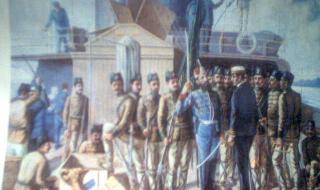
The day is May 29, 1876. The Austro-Hungarian steamer is making its regular course on the Danube River. The ship is full of goods, rich merchants and passengers. At around 12.30 a whistle blows three times. Hristo Botev, Dimitar Ikonomov and Nikola Voinovski, dressed in uniforms, came out on deck. They were armed with a saber in their right hand and a revolver in their left.
Thus the famous Bulgarian poet hijacks the Austrian ship "Radetzky".
After the signal - 3 blows of the whistle, a great commotion occurred excitement.
The Chetniks changed into their uniforms in seconds
and threw away their old clothes.
They smashed the chests and took out their weapons. They transformed from ordinary passengers into an army. Voinovski lined them up in two rows, and Botev stood in front of them. The remaining passengers were locked in first and second class to prevent any incidents. The entire ship was under control, and the captain had no choice but to fulfill the demands of the Bulgarian Chetniks.
On 16 and 17 (28 and 29 new style) May 1876, Hristo Botev and “200 Bulgarian heroes”, from various Romanian ports, boarded the Austrian steamer “Radetzky”. They forced the captain Dagobert Englander to stop near Kozloduy, where the detachment disembarked and the boys kissed the “sacred land of Mother Bulgaria”. From there they set off at a brisk pace for Vratsa, but received no support on their way.
Botev did not consider himself a permanent voivode until the descent to the Kozloduy shore. He thought that he had only been nominated as such, and that the Chetniks should choose who would lead them. Initially, the Chetniks were to be led by Panayot Hitov and Filip Totyu, but after they refused to cross the Danube, the detachments were left without a commander-in-chief. They united, and Botev was appointed chief voivode. After disembarking on the Bulgarian shore, the first thing the detachment had to do was choose a leader.
The poet was elected unanimously.
On May 18, the Chetniks took their first prolonged battle on the Milin Kamak hill. That same night they broke through the encirclement and withdrew to the Veslets area. They made unsuccessful attempts to contact the revolutionary activists in Vratsa. Early in the morning of May 20, the detachment took up positions around the three peaks of Kamarata, Kupena and Okolchitsa.
They fought a battle with a regular Turkish army - against the 205, over 4,000 regular and irregular Turkish troops were raised to their feet. Botev, with the core of the detachment, was under Kamarata peak. In the evening, on May 20 (June 1), 1876, after the battle had subsided, at the foot of the southeastern slope of Kamarata peak, the brilliant poet and voivode Hristo Botev died, shot in the heart.
Captain Dagobert Englender provided important information about the capture of the steamer in a report to the central inspectorate in Vienna, written on May 30, 1876. It is clear from it that the “Radetzky“ was attacked on May 29 by rebels, an hour after it had sailed from the port of Becket.
This happened at 12:30 p.m.
According to the captain, no one suspected the loaded crates because they met the conditions. He was forced by six armed men to listen to the partisans. The captain sympathized with the partisans and even after the steamer arrived in the city of Vidin, he refused to transport the Turkish army. After the partisans' shouts of “Long live the captain“ and “Long live Franz Joseph“, Englander shook his cap and said quietly “Good luck“.
According to the captain's stories, Botev made him a very big impression. He was correct and before arriving at the Bulgarian coast, he called him to make sure that the ship's cargo and the cash register were intact. After the steamer disembarked, Botev's loud voice was heard. Everyone fell to their knees and kissed their native land.
After these events, the captain had to write a detailed report and be transferred to work in the upper Danube. He refused and his request was granted. He continued to work on the “Radetzky“, until in 1885. he was appointed head of the bureau in the navigation department. The captain conveyed his memories to Zahari Stoyanov in 1888. In 1925. he sent several very important relics for Bulgaria - the steamer's seal, the original flag with the Hungarian and Austrian coats of arms, the permit, a copy of the report, a copy of Botev's letter to him in French and two planks from the board on the steamer. All these items were personally handed over to Boris III by Englander's brother, who had a one-hour meeting with the Tsar. Kiril (Botev's brother), who also participated in the detachment, was also present. He sent a gift to the captain - a portrait of Botev.
On the initiative of Stoyan Zaimov in 1906, a decision was made
to build a military history museum near Svishtov on the occasion of 30 years of liberation. The idea is to use the Tekir Dere River, which will become a Danube arm and the place will become an eternal port of the “Radetzky“. For this purpose, the steamer had to be bought from the First Imperial Danube Shipping Company in Vienna. The National Assembly was convened to vote on the proposal made by Dimitar Petkov (Prime Minister). Unfortunately, he was killed on “Tsar Osvoboditel“ Boulevard and the idea remained unfulfilled and forgotten.
In 1926. a committee named “Tsar Osvoboditel“ was formed again, whose goal was to implement the project. Then all Bulgarians were called to help, so that money would not be asked either from the tsar – Boris III, nor from the National Assembly. 50 million leva had to be raised to support all the military-historical houses, monuments, parks, mausoleums and museums erected by the “Tsar Liberator” committee. After the news that in 1927 the steamer would be repaired, information was sought about its condition through a letter addressed to Tsar Boris III. The Svishtov Committee aimed to repair the “Radetzky”.
The truth is that in 1918 the steamer ceased to be used in Austria, and
in 1924 it was scrapped and then destroyed.
The Bulgarian state does not make any claims to it, although it is of great historical importance for our country. This is due to the inaction of several governments. For Austria, it is simply a ship that has fulfilled its purpose and can no longer be used.
It was not until 1960 that an initiative was taken in Bulgaria to restore the steamship. Donations were collected from workers and students. The steam tug "Plovdiv" (built in the same shipyard) was used, on the basis of which a replica of "Radecki" was built. Old drawings and photographs were used for this purpose. József Király also contributed at the age of 84. He worked as a painter on the original steamship and remembers what it looked like.
The new steamship was solemnly opened on the occasion of the 90th anniversary of the voivode's death. It docked on the Kozloduy coast on May 28, 1966. It is 57.4 meters long and 17.5 meters wide.
It was declared a museum and included in the Hundred National Tourist Sites of Bulgaria. On September 4 of the same year, it arrived in Vienna. The event was covered by all radios, televisions and newspapers. After repairs in 1988, the original steam engine was replaced with a diesel engine.
In 1973, during the wintering in the Ruse estuary, “Radetzky“ sank after heavy snowfall. The reason was the crew's negligence. The steamer was removed by a Bulgarian team from Varna. A Romanian floating crane and Soviet divers come to the rescue.
The letter of Hristo Botev to the captain and passengers of the steamer “Radetzky“
Mr. Captain!
Gentlemen passengers!
I have the honor to announce to you that there are Bulgarian rebels on this steamer, of whom I have the honor to be the voivode.
At the cost of our livestock and our agricultural implements, at the cost of great efforts and at the sacrifice of our goods, finally at the cost of everything that is most precious in this world (without the knowledge and despite the persecutions of the authorities in the country whose neutrality we respected), we have procured what we needed to come to the aid of our rebel brothers, who are fighting so bravely under the Bulgarian lion for the freedom and independence of our dear Fatherland - Bulgaria.
We ask the Lord that the passengers do not worry at all and remain calm. As for you, Mr. Captain, I have the heavy duty to invite you to place the steamer at my disposal until our disembarkation, while at the same time declaring to you that even the slightest resistance from you will place me in the sad necessity of using force and, against my will, taking revenge for the disgusting incident on the steamer "Germania" in Ruschuk in 1867.
In both cases, our battle cry is as follows:
Long live Bulgaria!
Long live Franz Joseph!
Long live Count Andrássy!
Long live Christian Europe!