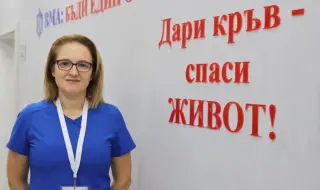
Blood and blood product transfusions help millions of people around the world every year. Don't be afraid to save lives too! Blood donation is useful because it stimulates the process of blood cell renewal and increases the body's defenses. But what else… Major Dr. Elisaveta Grancharova, part of the team of the Transfusion Hematology Center of the Military Medical Academy, spoke to FACTI.
-Dr. Grancharova, in Bulgaria hundreds of patients need blood transfusions every day. Have we learned to donate blood, or do we do it more often when a loved one needs it, and not so much with the awareness that we are helping?
- Happily, more and more often Bulgarians do not think about donating blood only when they or their loved ones need blood. The idea of free blood donation is being realized by more and more of our compatriots, a large part of them young people. And this depends on us ourselves - to talk about it in the family, to pay attention to this problem at school. Of course, there is still much to be desired, but things are going in the right direction. The tragedy in Kochani showed that Bulgarians are empathetic, ready to help - in three days hundreds responded to the Military Medical Academy for free. Some of them were donating for the first time then, and now they are returning to us again - without a reason. Young people, unpaid donors, often come with their children to instill a sense of responsibility in them.
Encouraging unpaid blood donation is one of the missions of the Military Medical Academy. Thousands of Bulgarians annually support our cause “Be one of us! Donate blood - save a life!”. In recent years, the Military Medical Academy has seen an increase in unpaid blood donors. Our entire team, led by Prof. Rumen Popov, is making enormous efforts for this and we see that the good attitude and professionalism do not go unnoticed. In addition, the center was completely renovated, we have the pleasure of working in the most modern Blood Center in Bulgaria, which also attracts donors.
- Each unit of donated blood can save up to three human lives, because…
- It doesn't happen often that a person has the opportunity to do something simple that can save the life of another. But that's exactly what happens every time blood is donated. Each donation can help save or improve the quality of life of at least three people. A standard amount of 450 ml of whole blood is taken from one donor, which, after a complex processing process, is divided into 3 different bioproducts: erythrocyte concentrate, fresh frozen plasma and platelet concentrate. And each of these bioproducts can be applied to three different patients, since the main principle of modern transfusion therapy is for the patient to receive the blood component he needs.
- When a person is taking medication, can he donate blood? What are the requirements for donating blood?
- There is still no alternative to blood, and the only way to obtain it is from donors who meet certain criteria. Generally speaking - any healthy person between the ages of 18 and 65, weighing over 50 kg, who has no chronic diseases and is not currently taking medication, has not undergone surgical interventions/tattoos in the last 12 months, can donate blood. Each potential donor undergoes an examination to assess their health status. Whether they can donate while taking medication depends on the condition for which they are being taken and the type of medication. Sometimes it is possible for a donor to be postponed for a certain period of time at the doctor's discretion. And the donation process itself takes no more than 30 minutes.
- How often can blood be donated?
- According to the current regulations in Bulgaria, men can donate blood five times within a calendar year, and women - four times, with the interval between two blood donations being at least 2 months.
- How long does it take for the body to restore the amount of donated blood?
- After donating blood, it takes about 24 hours for the body to quantitatively restore the donated volume of blood, and about 4-6 weeks for the red blood cells to qualitatively restore. The body produces about 2 million erythrocytes every second. However, it may take several weeks to replace the blood taken during blood donation. That is why the minimum period between two blood donations is 2 months. Most people feel well after donating blood, but it is important to rest, hydrate and avoid physical activity.
- Alcohol, cigarettes - if we use them regularly, can we donate blood?
- Smoking, in itself, is not a factor that would lead to rejection of a potential donor, but it is recommended to refrain from smoking for at least an hour before and after donation. Nicotine affects blood pressure - most often to its increase, and accelerates the pulse, which may be a reason for postponing blood donation. In addition, smoking after blood donation can lead to dizziness or vertigo. Alcohol consumption is not recommended either before or after blood donation, and an interval of at least 24 hours must be ensured. Alcoholic beverages dehydrate the body, and may also negatively affect the donated blood. My appeal - every healthy person who meets the criteria for a donor, to spend 30-40 minutes of their free time to donate blood. Because you do not need to have a medical education to help. Each of you can become a hero for someone by saving their life by donating blood. I would also like to thank the thousands of brave hearts, our like-minded people, who support the Military Medical Academy in the battle for human life. On an annual basis, we report more than 7 thousand blood donors, half of whom are military personnel and civilian employees of the military formations. It is gratifying for us that more and more civilian structures want to join our initiatives to encourage unpaid blood donation. Our mobile teams are ready to conduct similar actions throughout the country. We have 3-4 blood donations per week, outside the hospital, which can only please us. This shows solidarity and community affiliation in solving this problem.
Link to main version
Jun 20, 2025 13:15 2 066
What we need to know when donating blood… Major Dr. Elisaveta Grancharova told FACTI
Men can donate blood five times within a year, and women – four times, and the interval between two blood donations should be at least 2 months, says the physician
Снимка: Личен архив