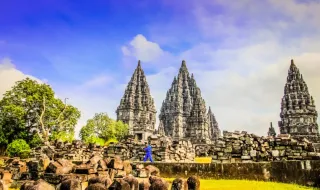
In Yogyakarta, the past is not separated from the present. It appears in the sultan's palace, in the narrow streets around it, in the murals on the facades and in the ancient temples located outside the city.
Yogyakarta is a rare example of a sultanate within a republic. In the local Javanese language, the name is often shortened to “Jokja“, and the city remains the cultural center of the island of Java. It is home to modern cafes, street vendors, batik and pop music, but also a palace order that dates back to the 18th century.
The palace at the center of a cosmological axis
The heart of the city is the Kraton - the sultan's palace, which is still home to Sultan Hamengkubuwono X and his family. A significant part of the complex is open to visitors. Every pavilion, image and sculpture has a symbolic meaning related to Javanese ideas about the world.
Yogyakarta is planned along an axis between the Indian Ocean to the south and the active volcano Merapi to the north. The Kraton is placed at the center of this connection between the earthly and the heavenly. UNESCO has included the “Cosmological Axis of Yogyakarta and its Historical Landmarks“ on the World Heritage List in 2023.
Not far away is Taman Sari - a water palace, whose name can be translated as “garden of fragrance“ or “beautiful garden“. In its center is a pool, the color of which changes between green and blue depending on the light. After the exit from the complex begins the tourist district, where local artists paint murals, sell batik and silverware and prepare civet coffee.
Borobudur tells a story in stone
A journey outside Yogyakarta takes you to Borobudur - one of the most impressive Buddhist temple complexes in the world. Its massive stone structure resembles a lotus and rises above the plains of Central Java. The temple was built in the 8th and 9th centuries, when Buddhist and Hindu dynasties ruled the island.
Later, Borobudur was abandoned after much of Java's population converted to Islam, but it was not destroyed. Panggah Ardiyansyah, a lecturer at SOAS University of London and a specialist in the history of art and archaeology of Southeast Asia, describes it as a "sacred" site even today.
“People in ancient times tried to tell stories through reliefs, wall paintings and statues. You can try to understand them yourself - connect them with the manuscripts and read them”, says Ardiyansyah.It is the reliefs that are among the most valuable details of Borobudur. They show scenes from the life of the Buddha and turn the walls of the temple into a stone narrative. For visitors seeking a more contemplative experience, tradition calls for a clockwise tour of the temple. In Buddhism, the number 108 holds special significance, so the most ardent devotees make 108 rounds.
Borobudur's history also includes the long journey of its artifacts outside Indonesia. Many statues and reliefs were exported abroad, and the Netherlands has been returning some of its colonial artifacts to the country in recent decades.
Sources: CNN