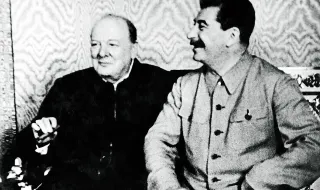
A piece of paper, a few percentages and a brief conversation in the Kremlin became one of the most famous symbols of the post-war division of Europe. On October 9, 1944, British Prime Minister Winston Churchill and Soviet leader Joseph Stalin discussed how to divide the spheres of influence in the Balkans.
The meeting took place during the Moscow Conference, which lasted from October 9 to 19. The conversation about the Balkans was held without the American representative Averell Harriman. Churchill later described the scene in his memoirs with the words: “Let us settle our affairs in the Balkans.“ He then wrote down his proposals on a sheet of paper and handed it to Stalin.
Percentages on a sheet of paper
According to Churchill's account, Romania was to be 90 percent in the Soviet sphere and 10 percent in that of the other Allies. For Greece, the reverse ratio was written down - 90 percent British and 10 percent Soviet influence. Yugoslavia was divided equally, and for Hungary a ratio of 50:50 was proposed. Bulgaria was listed as 75 percent Soviet and 25 percent Western influence.
Stalin put a check mark on the sheet. It was this gesture that gave the agreement its popular name - the "percentage agreement". Churchill later called it the "naughty agreement" because it was reached unofficially and behind the backs of the other Allies.
Historical documents show that the percentages were not entirely sustainable. In subsequent diplomatic talks, other ratios were found, including 80 percent Soviet and 20 percent Anglo-American influence in Romania and Bulgaria. The American diplomatic legacy describes the agreement as informal and notes that the exact meaning of the percentages remains unclear.
What happens after the agreement
Churchill sought a guarantee that Britain would retain a decisive role in Greece, where the communist resistance movement had significant influence. In return, the British government accepted a predominant Soviet role in Romania and Bulgaria – countries where the Red Army already had a military presence.
In December 1944, heavy clashes began in Athens between British forces and Greek communists. In a letter to Franklin Roosevelt in March 1945, Churchill indicated that Stalin respected the understanding reached and did not intervene on the side of the communist forces.
In practice, the promised balance was not established equally in all countries. Romania, Bulgaria and Hungary fell under dominant Soviet influence, while Greece remained in the Western camp after the end of the Civil War in 1949. Yugoslavia also took an independent path under the leadership of Josip Broz Tito and gradually moved away from Moscow.
The percentage agreement is not a formal treaty and does not erase the role of armies, local political forces and subsequent decisions of the allies. However, it remains a brief and telling record of the way Britain and the Soviet Union attempted to shape the post-war order in Southeast Europe.
Sources: theguardian.com, romania-actualitati.ro