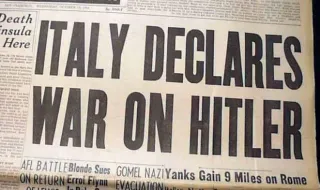
On October 13, 1943, the Kingdom of Italy declares war on Nazi Germany. The decision is announced by Prime Minister and Marshal Pietro Badoglio on behalf of King Victor Emmanuel III. Thus, Italy officially confronts the state with which it had been an ally within the Axis until then.
“Italians! There will be no peace in Italy as long as not a single German remains on Italian soil“, Badoglio declares in his proclamation. He accuses German troops of having disarmed Italian units and attacked other formations after the rupture between Rome and Berlin. The quote was reported by the American news agency UPI in its announcement of the declaration.
From the overthrow of Mussolini to the armistice
The change began on July 25, 1943, when Benito Mussolini was overthrown. King Victor Emmanuel III appointed Pietro Badoglio as prime minister, but the new government did not initially declare an immediate break with Germany. At the same time, it conducted secret negotiations with the Allies.
On September 3, 1943, Italy signed an armistice with the United States, Great Britain and their allies in Cassibile, Sicily. It was announced publicly on September 8. On the same day, the German command launched Operation “Axe“ and began the occupation of Italian territory.
The Italian army was left without clear instructions and was disarmed by the Germans in many places. Badoglio's government and the royal family left Rome and settled in Brindisi, in the southern part of the country, which gradually fell under Allied control.
Italy received the status of a belligerent country
The declaration of October 13 did not automatically make Italy an equal member of the anti-Hitler coalition. In a joint statement, US President Franklin Roosevelt, British Prime Minister Winston Churchill and Soviet leader Joseph Stalin accepted the "active cooperation" of the Italian people and armed forces as belligerents against Germany. However, they stressed that the terms of the armistice remained in force.
This clarification is also important because of the political division of the country. In the northern part, occupied by German troops, Mussolini was returned to lead the Italian Social Republic. In the south, the royal government began to support Allied operations, although Italian participation in the fighting was initially limited.
The historical turn is often described as a "change of sides", but the wording requires clarification. On 13 October 1943, Italy declared war specifically on Germany, rather than on all Axis powers simultaneously. It did not declare war on Japan until 15 July 1945. The date therefore marked the beginning of Italy's co-belligerent role against Germany, rather than an immediate joining of the Allies on equal terms.
Sources: upi.com, history.com, theguardian.com