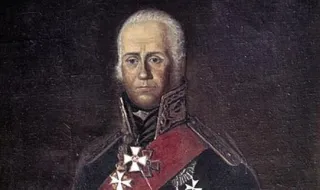
When Fyodor Ushakov died on October 14, 1817, in his estate in Alekseevka, behind him were already decades of service, several wars and victories that changed the perception of naval combat. He was buried in the Sanaksar Monastery, near which he spent the last years of his life.
The date is October 2 according to the Julian calendar. Reference books also differ on the year of his birth – 1744 or 1745. Official Russian historical and church sources indicate 1745 as the year in which Ushakov was born in the village of Burnakovo, Yaroslavl Province.
From the Cadet Corps to the Black Sea
In 1761, Ushakov entered the Naval Noble Cadet Corps. He completed five years of training in 1766 and began service as a midshipman. His first assignments were related to the protection of Russian sea routes, but he gradually moved to the Black Sea - an area that became the main scene of his career.
Ushakov participated in the construction and strengthening of the Russian Black Sea Fleet. In the Russo-Turkish War of 1787-1791, he commanded the vanguard, and later the entire fleet. At Fidonisi in 1788, the Russian squadron struck at the Ottoman forces. This was followed by victories at the Kerch Strait and Tendra Island in 1790, and on August 11, 1791 - the Battle of Cape Kaliakria.
Kaliakria is located on the present-day Bulgarian Black Sea Coast. In the battle, Ushakov attacked the Ottoman squadron, using its proximity to the coast and sudden maneuvering. According to historian Darina Mircheva from the Historical Museum in Kavarna, he introduced a new tactic, with which he defeated a fleet that was superior to the Russian forces in terms of numbers and armament.
The Mediterranean Campaign and Corfu
After the Black Sea victories, Ushakov led a Russian-Turkish squadron in the Mediterranean. During the campaign of 1798-1800, he participated in the actions against the French forces holding the Ionian Islands. In 1799, Russian sailors and their allies captured Corfu - a fortress considered one of the strongest in Europe.
His military style was based on maneuver, rapid concentration of forces and an attack on the most important part of the enemy formation. Instead of waiting for the outcome of a prolonged artillery exchange on parallel lines, Ushakov looked for the place where one blow could change the entire course of the battle.
The last years and the memory of the admiral
Ushakov received the rank of admiral in 1799. A few years later he retired from active service. During Napoleon's invasion in 1812, he was elected chief of the Tambov militia, but due to his deteriorating health, he did not take up the position. Instead, he provided personal funds for the formation of a regiment and a military hospital.
His last years were spent in solitude and charity. The then abbot of the Sanaksar monastery, Hieromonk Nathanael, described him as a “neighbor and famous benefactor of the Sanaksar monastery“. After his death, his coffin was carried to the monastery, where he was buried next to his relative - the monk Feodor of Sanaksar.
In 2001, the Russian Orthodox Church canonized him as a locally venerated saint, and in 2004 he was included among the universal saints in the image of the righteous warriors. The name of Admiral Fyodor Ushakov remains associated simultaneously with the history of the Russian fleet, with the battle of Kaliakria, and with the image of a military leader who, after the end of his service, chose a quiet life near a monastery.
Sources: old-news.bnr.bg, bta.bg