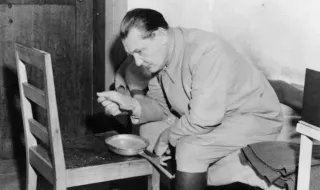
The execution site in Nuremberg was already prepared when Hermann Göring spent his last night as a prisoner. The highest-ranking surviving leader of Nazi Germany was sentenced to death by hanging, but did not live to see his sentence carried out. On the night of October 15, 1946, he took a cyanide capsule and died in his cell, just hours before his scheduled execution.
Göring was born on January 12, 1893 in Rosenheim, Bavaria. During World War I, he served as a fighter pilot, commanded a squadron and was awarded the Order of the “Pour le Mérite“ -ndash; the highest military decoration of the German Empire. After the war, he turned his reputation as a war hero into political capital.
From fighter pilot to second-in-command in the Reich
In 1922, Göring joined Adolf Hitler's party and soon took command of its stormtroopers. He was seriously wounded in the failed Beer Hall Putsch in Munich in November 1923, after which he left Germany. He returned after an amnesty and in 1928 was elected a deputy to the Reichstag. Four years later he became its president.
On January 30, 1933, when Hitler was appointed Chancellor, Göring entered the government. As Minister of the Interior of Prussia, he participated in the construction of the regime's repressive apparatus. He was among the people who transformed the Nazis' political power into a system of police, prisons and persecution of opponents.
Göring led the Luftwaffe from its creation in 1935, and in 1936 he took over the Four Year Plan, which mobilized the German economy for war. In 1939, Hitler named him his successor. The following year he was given the specially created title of Reichsmarschall.
The signature under the “Final Solution“
Göring's role was not limited to military and economic matters. On July 31, 1941, he signed an order to Reinhard Heydrich to prepare a plan for the so-called Final Solution of the Jewish question in the territories occupied by Germany. The document is among the key pieces of evidence for the involvement of the Reich's top leadership in the policy of systematic extermination of European Jews.
After the military defeat, Göring surrendered to American forces on May 7, 1945. In Nuremberg, he was the leading defendant in the trial of the leaders of Nazi Germany. During the hearings, he defended the regime and denied responsibility for a number of crimes. In his last statement before the tribunal, he stated: “If I had to start all over again, I would do as I did.“
The capsule in the cell
On October 1, 1946, the International Military Tribunal found him guilty of conspiracy to commit crimes against peace, crimes against peace, war crimes, and crimes against humanity. The court sentenced him to death by hanging, and Göring asked to be shot instead of hanged. His request was denied.
On his last night in his cell at Nuremberg prison, he was in a cell. According to the story presented by PBS, shortly before 11 p.m., a guard noticed Göring gasping for breath and clutching his face. It turned out that he had broken a potassium cyanide capsule. After he was found, a doctor pronounced him dead.
Where exactly he got the poison from remains unclear. Various versions have been put forward over the years, including that the capsule was hidden among his personal belongings or that it was given to him during his time in prison. What is confirmed is that Göring died on October 15, 1946, and the following night, ten of the other Nazi leaders sentenced to death were hanged.
Sources: history.com, cgi.pbs.org