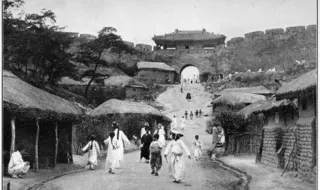
By the Taedong River, among the hills of the western Korean peninsula, Pyongyang looks like a 20th-century city. Wide boulevards, monumental buildings, and an almost completely planned cityscape belie the fact that the place has a history that stretches back much further than the modern state of North Korea.
In Korean tradition, Pyongyang is associated with Tangun - the legendary ancestor and founder of Ancient Joseon. According to legend, in 2333 BC, he founded his state and chose Pyongyang as its capital, before moving his court to Asadal. This date is part of the national historical tradition, but has not been confirmed as a specific event by archaeology. The first written accounts of Tangun appear much later, most notably in the “Samguk Yusa“, compiled in the 13th century.
The Capital of Goguryeo
The recorded history of Pyongyang certainly begins to take shape during the Goguryeo era - one of the most powerful ancient kingdoms in Northeast Asia. In 427, King Jangsuwan moved the capital from Kunseong, located near the present-day Chinese city of Jiang, to Pyongyang. The decision made strategic sense: the new location was closer to the agricultural regions of the Korean Peninsula and gave Goguryeo better access to trade routes.
In 586, the capital was moved to the fortified city of Jangsan. It was part of a larger capital complex that controlled important river valleys and passes. In the following decades, Pyongyang was the political, military, and religious center of Goguryeo, until the kingdom fell in 668 under the blows of Silla and the Chinese Tang dynasty. The historical source „Samguk Sagi“ indicates 427 as the year of the capital's relocation, and 668 as the year of the fall of Goguryeo.
„An exceptional testimony to the vanished Goguryeo civilization“ – is how UNESCO describes the complex of capitals and tombs associated with the ancient kingdom.The Western Capital of Goguryeo
After the fall of Goguryeo, the city experienced periods of decline, but did not disappear from history. During the Goguryeo dynasty, founded in 918, Pyongyang was given the role of the Western Capital – Seogyeon. The capital is Kaesong, but Pyongyang retains its importance as an administrative center for the western and northern lands.
This situation shows how enduring the city's historical significance was. The rulers of Goguryeo used the legacy of Goguryeo to emphasize their connection to the older kingdom and the idea of a unified Korean state. Later, during the Joseon Dynasty, Pyongyang was no longer the capital, but it remained an important city on the route between the interior of Korea and China.
From military center to industrial city
In 1894, one of the key battles of the First Sino-Japanese War was fought near Pyongyang. The battle demonstrated the city's strategic importance and accelerated its transformation into the center of the great rivalry between China, Japan, and Russia for influence over Korea.
In the early 20th century, the Korean Empire developed a plan to turn Pyongyang into a "second" or Western capital. The 1902–1908 project was intended to strengthen the city's administration and defenses, but was abandoned after Japan's victory over Russia and the subsequent establishment of Japanese control over Korea. In 1910, Japan annexed the peninsula, and Pyongyang began to develop as an industrial and transportation center.
The City That Started Over
The most dramatic turn in Pyongyang's history came during the Korean War. Between 1950 and 1953, much of the city was destroyed by bombing, and historic walls, gates, and buildings were severely damaged. After the war, the authorities did not simply rebuild the old city, but built a new capital with wide streets, large squares, parks, and massive public buildings. Soviet and Eastern European specialists participated in this reconstruction.
In 1972, the constitution of the Democratic People's Republic of Korea officially designated Pyongyang as the capital. Thus, the city received its modern political role, but its ancient past continues to be present in the fortresses, tombs, and stories of Goguryeo.
Today, Pyongyang is both an ancient symbol and a modern capital, almost completely changed by war and 20th-century ideology. This is precisely its most paradoxical image: a city that preserves the memory of the stone capitals of Goguryeo, but itself is built anew on the ruins of modern history.
Sources: encykorea.aks.ac.kr, db.history.go.kr, whc.unesco.org