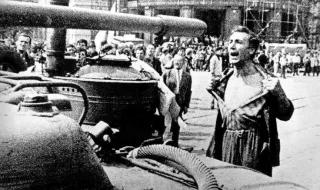
On October 16, 1968, Czechoslovakia signed a treaty with the USSR on the conditions of the temporary stay of Soviet troops on its territory. Thus, the military occupation, which had begun two months earlier, received a formal legal framework. The indicated date of October 15 is one day earlier than the actual date of signing. The treaty was signed on October 16, and was approved by the Czechoslovak National Assembly on October 18.
Reforms Stopped by Tanks
The Prague Spring began in early 1968, when Alexander Dubček headed the Czechoslovak Communist Party. The new leadership began political and economic liberalization, removed some censorship, and spoke of "socialism with a human face." The reforms did not envisage leaving the Warsaw Pact or breaking with the USSR, but Moscow saw them as a threat to its control over the socialist bloc.
On the night of August 20-21, Warsaw Pact troops entered Czechoslovakia. The operation was led by the USSR, and Poland, Hungary, and Bulgaria participated in it. Hundreds of thousands of soldiers were sent to the country, and the resistance of the population was mostly peaceful. More than 100 Czechoslovak citizens died, and Alexander Dubček and other representatives of the reformist leadership were taken to Moscow.
The Moscow Protocol and the End of Hope
Under pressure from Leonid Brezhnev, the Czechoslovak delegation signed the Moscow Protocol on August 26, 1968. Only František Kriegl refused to sign the document. The protocol provided for a return to the political course approved by Moscow and marked the beginning of normalization - the term used by the communist authorities to describe the restoration of full political control.
The military invasion effectively stopped the Prague Spring, but the October agreement marked its official and long-term end. Its first article stated that "part of the Soviet troops would remain temporarily" in Czechoslovakia to guarantee the security of the socialist community. The document does not specify a deadline for the complete withdrawal of Soviet forces.
At the same time, the treaty provides for the troops of Poland, Hungary, Bulgaria and the GDR to leave the country in stages. The Soviet contingent, however, remains. On October 18, the Czechoslovak National Assembly approves the agreement by an overwhelming majority - four deputies voted against and 10 abstained. Among the opponents is again František Kriegl.
The “Temporary” presence lasts until 1991.
Initially, the treaty regulates the presence of about 75,000 Soviet servicemen. Then the Central Group of Forces of the Soviet Army is deployed in Czechoslovakia. It remains there not for a few months, but for almost 23 years - until the fall of the communist regime and the subsequent withdrawal negotiations.
On February 26, 1990, Czechoslovakia and the USSR signed an agreement on the complete withdrawal of Soviet troops. The last Soviet serviceman left the country on June 27, 1991. Thus, the formulation of a “temporary“ presence, used in the 1968 treaty, ended only after the end of the Cold War and more than two decades after the crushing of the Prague Spring.
Sources: english.radio.cz, history.com