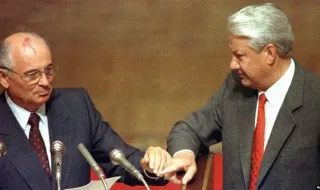
On October 15, 1985, Mikhail Gorbachev stood before a plenum of the Central Committee of the CPSU with a plan that was to accelerate the development of the Soviet economy by the end of the century. In the next 15 years, national income and industrial production were to almost double, and labor productivity - by up to 150 percent. "To almost double national income and industrial production" was one of the goals set by the Soviet leader.
At that time, Gorbachev was not yet proposing to abandon the planned economy. The idea was to modernize the system through better management, new technologies, greater autonomy of enterprises, and limited encouragement of cooperative initiative. The program was a continuation of the course towards “acceleration“, announced at the April plenum of the CPSU Central Committee in the same year.
From economic acceleration to perestroika
Gorbachev inherited an economy that had enormous industrial and military resources, but lagged behind in productivity, consumer goods and the introduction of new technologies. Central planning maintained control over production, prices and distribution, but enterprises had little incentive to improve quality or reduce costs.
In February 1986, the 27th Congress of the CPSU approved the course towards acceleration and renewal. Gradually, two other concepts were added to economic change - glasnost, or greater publicity, and democratization. After the Chernobyl accident in April 1986, restrictions on information began to be challenged even more strongly, and public pressure for openness grew.
In June 1987, the Law on State Enterprises expanded the powers of management and introduced principles of self-sufficiency. Enterprises were to be held more accountable for their results, but the basic mechanisms of the planned economy remained. In 1988, legal opportunities were created for cooperatives and limited private business activity, especially in trade, services, and catering.
Glasnost opens up the political system
Reforms gradually extended beyond the economy. In 1989, partially competitive elections were held for the Congress of People's Deputies of the USSR. Open criticism of the privileges of the party apparatus, past repressions, and failures of state governance emerged in public life.
In March 1990, the CPSU's constitutional monopoly on political power was abolished. Gorbachev was elected president of the USSR, but the reforms had already given rise to forces that did not only want a renewed socialist system. Movements for sovereignty and independence grew in the republics, and in Russia, Gorbachev's most visible opponent was Boris Yeltsin.
Yeltsin was elected chairman of the Supreme Soviet of the RSFSR in May 1990. On June 12 of the same year, Russian legislation declared the supremacy of Russian laws over those of the Union. A year later, on June 12, 1991, Yeltsin was elected President of the Russian Federation by direct vote.
The coup accelerates the collapse
On August 19, 1991, conservative party and state leaders attempted to overthrow Gorbachev and stop the signing of a new union treaty. Yeltsin turned the Russian parliament building into a center of resistance and appeared before his supporters on a tank. The coup failed within three days, but Gorbachev emerged politically weakened, and Yeltsin became the most influential figure in Russia.
On December 8, 1991, Russia, Ukraine, and Belarus signed an agreement to create the Commonwealth of Independent States. On December 25, Gorbachev resigned as President of the USSR, and the next day the Soviet Union ceased to exist.
Then began the Yeltsin era. In January 1992, the government liberalized most prices and accelerated privatization, making the transition to a market economy a major state policy. Thus, the course that began as an attempt to repair the Soviet model ended with its abolition and the birth of a new Russian state.
Sources: washingtonpost.com, latimes.com, upi.com