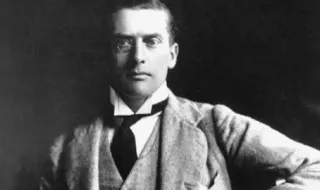
On October 16, 1925, exactly on his 62nd birthday, Austin Chamberlain signed the documents that were to restore trust between former enemies in Europe. The place was the Swiss city of Locarno, and the result was a series of treaties between Great Britain, France, Germany, Italy, Belgium, Poland and Czechoslovakia. A year later, Chamberlain received the 1925 Nobel Peace Prize together with the American financier Charles Dawes.
His name is often overshadowed by his father Joseph Chamberlain and his half-brother Neville Chamberlain. Austin himself, however, spent 45 years in the House of Commons and held some of the most important posts in British politics. He was Chancellor of the Exchequer twice, Minister for India, Leader of the House of Commons and Foreign Secretary from 1924 to 1929.
A politician by inheritance, but not by accident
He was born in Birmingham on 16 October 1863, the eldest son of Joseph Chamberlain. His mother died at his birth, and his father gradually became one of the most influential figures in British public life. Austin was educated at Rugby School and Trinity College, Cambridge, after which he spent nine months in Paris and a year in Berlin. This European experience later proved important for his diplomatic career.
In 1887 he returned to Birmingham and began working closely with his father. He entered Parliament in 1892 as the representative of East Worcester. His first speech in the House of Commons was so well received that William Gladstone described it as one of the best he had ever heard.
Locarno and the brief triumph of reconciliation
As Foreign Secretary, Chamberlain supported the negotiations with Germany, led together with the French Minister Aristide Briand and the German Foreign Minister Gustav Stresemann. The Locarno Treaties guaranteed Germany's western borders and provided for disputes to be settled by arbitration rather than war. Germany embarked on a path towards joining the League of Nations, and there was a brief sense in Europe that lasting peace was possible.
“This is the beginning, not the end“ - this is how Chamberlain described the significance of Locarno to the British Parliament. The expression turned out to be prophetic, but also ambiguous. The agreements reduced tensions in the second half of the 1920s, but did not eliminate the contradictions in Central and Eastern Europe. After Adolf Hitler came to power, German policy changed, and in 1936 the remilitarization of the Rhineland dealt a severe blow to the system built in Locarno.
Why his name is less familiar today
Chamberlain did not become prime minister, although he headed the Conservative Party in 1921. His political career was interrupted by the crisis surrounding the coalition government of David Lloyd George. When the Conservatives abandoned the coalition in 1922, Chamberlain lost the leadership and thus missed the opportunity to reach “Downing Street“.
In 1925 he was also awarded the Order of the Garter. He died in London in March 1937, just two months before his half-brother Neville became Prime Minister. The definition “second most popular British politician after Churchill“ cannot be proven as a historical ranking. It is more accurate to say that Austen Chamberlain was among the key British statesmen of the interwar period – the politician who briefly transformed European reconciliation from hope into an international treaty.
Sources: theguardian.com