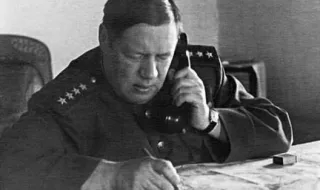
On October 17, 1949, Fyodor Ivanovich Tolbukhin died in Moscow - Soviet marshal, commander of the 3rd Ukrainian Front at the end of World War II and one of the key figures in the events that led to the entry of Soviet troops into Bulgaria in September 1944.
Tolbukhin was born on June 16, 1894 in the village of Androniki, Yaroslavl Province. He came from a peasant family, but his military career began in the army of the Russian Empire. He participated in World War I, and after the revolution in 1917 he joined the Red Army. From there, he gradually rose to a high command position.
From Stalingrad to the Balkans
During World War II, Tolbukhin led the 57th Army in the Battle of Stalingrad, and later commanded the Southern Front and the 4th Ukrainian Front. From May 1944, he headed the 3rd Ukrainian Front, which participated in operations in Romania, Bulgaria, Yugoslavia, Hungary and Austria.
On September 7, 1944, the day before the Soviet troops crossed the border, Tolbukhin signed an address to the Bulgarian people. It stated: „The Red Army has no intention of fighting the Bulgarian people and their army, as it considers the Bulgarian people to be fraternal.“
On September 8, units of the 3rd Ukrainian Front entered Bulgaria. The Bulgarian army offered no resistance, and the next day a political coup was carried out in Sofia, bringing the Fatherland Front government to power. Tolbukhin remained associated with these events not only as a military commander, but also as a representative of the Soviet leadership in post-war Bulgaria.
Chairman of the Allied Control Commission
Since November 1944, Tolbukhin has been chairman of the Allied Control Commission, established after the signing of the armistice between Bulgaria and the Allies. On November 17, he and the commander of the Bulgarian army, General Ivan Marinov, agreed on the continued participation of Bulgarian troops in the war against Germany.
A First Bulgarian Army was created with about 130,000 men, led by General Vladimir Stoychev. The army was placed under the direct command of the command of the 3rd Ukrainian Front. The Bulgarian units fought heavy battles in the winter of 1944-1945, participated in the Drava epic and in the offensive towards the Mur River.
His name in Bulgarian memory
In 1946, Tolbukhin was declared an honorary citizen of Dobrich and Vratsa. Just days after his death, on October 20, 1949, Dobrich was renamed Tolbukhin. The city bore this name until September 1990, when the historical name Dobrich was restored.
In Sofia, his name was given to today's boulevard “Vasil Levski“, which until 1990 was called boulevard “Tolbukhin“. Thus, the presence of the marshal in Bulgaria remains not only in the archives of the war and the armistice, but also on the map of cities - as a sign of an era, the assessments of which are now read through the complex history of 1944 and the post-war years.
Tolbukhin was posthumously awarded the title of Hero of the Soviet Union in 1965. He was buried near the Kremlin Wall in Moscow.
Sources: archives.bnr.bg, dobrichmuseum.bg, dobrich.bg