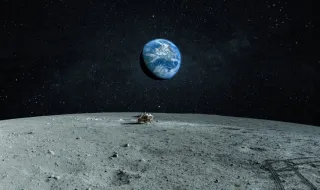
What time is it on the Moon when it is noon in Paris? Scientists are trying to answer this question, as the creation of a single standard for lunar time is essential for the future study of Earth's natural satellite, reports AFP, Vesti.bg reports.
At the 28th General Conference on Weights and Measures in Versailles, member states of the organization that develops international standards in metrology adopted a resolution to create an “international reference scale for lunar time“.
On Earth, smartphones, computers and other connected devices use Coordinated Universal Time (UTC) - the official time scale. However, it cannot be directly applied to the Moon, because time flows faster there - an effect predicted by Albert Einstein in his general theory of relativity. Two clocks synchronized on Earth would deviate by 56 microseconds per day if one were sent to the Moon.
Although the difference seems negligible, it is important for the accuracy of space operations. “It is about helping spacecraft land precisely on the Moon, as well as for the orientation and movement of rovers or astronauts there“, recalls Pascal Defren, a physicist at the Royal Observatory of Belgium. According to Joel Parker of NASA, navigation with an accuracy of one meter on the Moon requires timing accuracy on the order of one nanosecond.
To provide such capabilities, space agencies of the United States, China, India, Japan, Europe and other countries plan to place navigation satellites in orbit around the Moon. “To promote compatibility and operational reliability among all providers and users of positioning, navigation and time synchronization services on the Moon, it is important to adopt common definitions,“ Parker explains.
Astronomers already use Lunar Coordinate Time (LCT) in their calculations, but some space agencies prefer derivatives of it that they consider more suitable. It remains to be decided which reference system to adopt and how lunar time will be related to Earth time.
On Earth, UTC is determined based on the average values of about 500 atomic clocks located around the world. It is not clear whether a similar network will be needed on the Moon, who will build it, and who will be responsible for it. An additional challenge is determining a “zero” altitude for calibrating the clocks. On Earth, this reference point is sea level, but the Moon has no direct equivalent.
These are just some of the issues that metrologists, astronomers, geophysicists, surveyors, international organizations, and space agencies will have to agree on in the coming years.