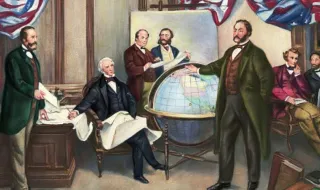
On October 18, 1867, the Russian flag was taken down in Sitka, and the flag of the United States was raised in its place. Thus, Russian rule over Alaska, purchased by Washington for $7.2 million, officially ended.
The deal had been negotiated months earlier. On March 30, 1867, U.S. Secretary of State William Seward and Russian diplomat Edward de Stockel signed the treaty ceding the territory. The Senate ratified it on April 9, and President Andrew Johnson signed it on May 28. However, the formal handover did not take place until October in the then capital of Russian America – Sitka.
Why Russia gave up the territory
Russian presence in North America began in the 18th century, but governing the vast and remote territory proved difficult and expensive. Alaska was far from the main centers of the empire, and defending it would have been complicated in the event of a conflict with Britain, which controlled neighboring Canada.
Moscow preferred to receive money for the territory rather than risk losing it without compensation. For Seward, the purchase was a way for the United States to expand its influence in the North Pacific. The treaty gave Washington a territory of 586,412 square miles - an area more than twice the size of Texas. The price was less than two cents per acre.
„Seward's Folly“
In the United States, the deal initially drew ridicule. Some politicians and journalists considered Alaska a cold, barren, and economically useless territory. Thus, the nicknames "Seward's Folly", "Seward's Icebox", and "Andrew Johnson's Polar Bear Garden" appeared.
During the ceremony in Sitka, the Russian commissioner Alexei Pesthurov uttered the words: "By order of His Majesty the Emperor of Russia, I am handing over to the United States the territory of Alaska." American General Lovell Rousseau accepted the handover on behalf of Washington.
The Check, Gold, and the Change in Valuation
The payment was not made on the day of the ceremony. On August 1, 1868, the U.S. Treasury Department issued a check for $7.2 million, with which Russia received the agreed amount. The document is now among the most famous financial traces of the purchase.
The assessment of the deal began to change after the discovery of gold in Alaska and nearby areas in the late 19th century. The gold rush attracted thousands of prospectors and settlers, and later the territory became an important source of oil and other natural resources. Alaska became the 49th state of the United States on January 3, 1959.
The negotiations involved only Russia and the United States. The indigenous peoples of Alaska were not invited to the table, although they inhabited the lands long before the appearance of Russian settlements. This is one of the important differences between the diplomatic narrative of the purchase and the history of the people who already live in the territory.
Sources: history.com, apnews.com