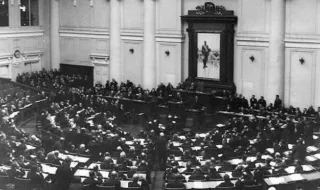
On October 30, 1905, in a new style, Emperor Nicholas II signed the October Manifesto - the document that for the first time promised the subjects of the Russian Empire civil liberties and the participation of an elected representative body in legislation. According to the old calendar, the date is October 17. The manifesto was signed in Peterhof, near St. Petersburg.
The decision was reached at the height of the Russian Revolution of 1905. A general strike blocked the railways, factories and state administration, and the authorities were faced with a choice between suppressing the crisis by force and making political concessions. Finance Minister Sergei Witte urged Nicholas II to adopt reforms and warned that without change the empire could be pushed into an even deeper revolution.
What the October Manifesto Promises
In the document, the emperor ordered that “freedom of conscience, speech, assembly and association“ be granted. It also provided for the expansion of voting rights for groups of the population that had not previously participated in elections.
The most significant change was related to the State Duma. The manifesto stated that “no law could come into force without the approval of the State Duma“. The elected representatives were also promised the opportunity to exercise real control over the legality of the actions of the officials appointed by the emperor.
Thus, Nicholas II effectively retreated from unlimited autocracy and initiated a limited constitutional monarchy. The manifesto succeeded in dividing the opposition, with moderate liberals accepting the promised reforms, while revolutionary parties considered them insufficient.
The constitution came in 1906.
The claim that the first constitution of Russia was proclaimed on October 30, 1905, is inaccurate. On that date, a manifesto was issued that laid the foundation for the parliamentary system. The constitutional framework itself was approved by the Fundamental State Laws of April 23, 1906.
The new model did not turn Russia into a full parliamentary monarchy. The State Duma became the lower house, and the State Council – upper house, half of its members appointed by the emperor. Nicholas II retained control over the government, the army, and foreign policy, as well as the right to dissolve the Duma. Legislative decisions were subject to imperial approval.
The first State Duma began work on April 27, 1906, but its relations with the palace quickly deteriorated. It was dissolved on July 8 of that year, after operating for a little over two months. Despite its short existence, the Duma remains the first attempt at representative legislation in modern Russian political history.
Sources: history.com, encyclopedia.com