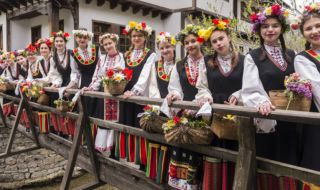
The Orthodox Church celebrates today the church holiday of Lazarus Day, which is always on the penultimate Saturday before Easter.
Traditionally, on Lazarus Day, green willow branches are plucked, which will decorate the doors the next day - Palm Sunday (Palm Sunday).
Lazarus Day or Lazarnitsa is a Christian holiday named after Saint Lazarus. In the New Testament, Lazarus is a disciple of Christ and the brother of Martha and Mary Magdalene, whom Jesus brings out of the grave and brings back to life. According to tradition, Lazarus lived another 30 years and died as bishop of the city of Kiton (island of Cyprus). The very name of the saint is a symbol of health and longevity.
On this day, the custom of lazaruvane and the rites of passage are performed. According to beliefs in Northeastern Bulgaria on Vrabnitsa, they "dismiss, let go" of the dead from the graves. To show their respect for them, the Lazarus All Souls' Day is organized.
On the eve of Lazarovden, women go to the cemetery, anoint and pour wine over the graves of their loved ones and distribute a rangelov kravai, wheat for their souls. That evening or on Lazarovden, each housewife distributes small prosforki in the village, according to the number of deceased, but always an odd number.
According to old Bulgarian traditions and customs, preparations for Lazarovden begin early. An older woman, who has long been a lazarus dancer, helps the girls learn the songs that they will perform as they go around the village. Most of them sing, while the rest dance, since Lazarovden is a holiday of both female choral song and dance.
On this day, the festive rite begins early in the morning. The girls are divided into groups of 5-6 lazarus and begin to go around the village dressed in bridal clothes. In different parts of Bulgaria, the girls wore different clothes. In Eastern Thrace, for example, the lazarus wore new bridal clothes to "shake them for hair". In the Kyustendil region, the girls carried a handkerchief in their hand, with which the bride "bowed" at the wedding - the so-called "klanyachka", and in Shopluka their heads were decorated with a bunch of silk grass and a beautiful peacock feather.
Ladies and girls who start preparing themselves during the fasts take part in the lazaruvan, they are grouped by age and in groups. In the group there are singers, shetalitsi, one of the lazaruks carries a basket of eggs. They go around the village on Saturday from noon and Sunday until noon, entering each house, singing a song for each member of the family. They play an unaccompanied lazaruk dance. According to folk beliefs, the mistress of the house must necessarily give each lazaruk with a raw egg, which symbolizes immortality. In addition, spells were broken with it and fortune-telling was done for the future. It is believed that a house visited by lazars is happy and blessed.
In the Bulgarian tradition, Lazarovden is a holiday of the fields, pastures and forests, but also a holiday of girls who, after lazaruvat, can publicly court each other, dress and behave in a way that bachelors like them, have a lover, and get married.
The day is also called Lazarova Saturday, Lazaritsa, Lazar. Three rituals are associated with it - lazaruvat, choosing a godmother and boenek. All three are associated with the transition to bachelorhood, with love and homemaking.
The Easter celebration begins on Lazarov Saturday. During the Holy Liturgy on Lazarus Day, the Church glorifies Christ as the Resurrection and Life, who, even before His suffering and death, with the resurrection of Lazarus, established the prototype of the universal resurrection of humanity. It was precisely because of the resurrection of Lazarus that Christ was glorified by the people as the long-awaited Messiah, the King of Israel, as the fulfillment of the Old Testament prophecies.
At Vespers before the feast of the Lord's Entry into Jerusalem (Palm Sunday, Palm Sunday, Palm Sunday), the prophecies about the King-Messiah from the Old Testament are read together with the Gospel accounts of Christ's entry into Jerusalem.
On Palm Sunday, during Matins, willow branches are blessed and distributed to the worshipers. We hold branches in our hands throughout the Liturgy, thus showing that we, like the ancient inhabitants of Jerusalem, welcome Jesus Christ as King and Savior.
On Lazarus' Day, the name day of Lazarus, Lazo, Lacho, Lachezar is celebrated.