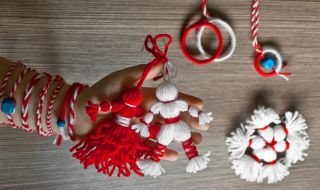
As we all know, in Bulgaria we celebrate March 1st by decorating ourselves with martenitsa – intertwined red and white threads, which nowadays can come in all sorts of variations.
History and symbolism of martenitsa
This is an old tradition, the origin of which has different versions. It is believed to be entirely Bulgarian, some researchers claim that it dates back to the time of Tsar Kaloyan, others – to Asparuh, and still others say that it has Thracian roots. However, a similar symbol with red and white thread is also popular in some countries in the East, as well as in other parts of the Balkans.
However, the symbolism is everywhere connected with one thing – This is an amulet that bestows long life, health, strength and abundance, and can be hung on a person, animal or even in the home. In our country, martenitsa is used to mark a new beginning and the approach of spring.
There are various beliefs, according to which martenitsa was tied to the little finger of the left hand of bachelors, married men - on the ankle or tucked into the belt, and for maidens and brides, respectively, on the left and right of the bosom. Nowadays, we most often tie martenitsa to the wrist or hang them on clothes, most often on the left side of the chest.
There are also different beliefs about how long martenitsa should be worn and when to take them off, and they are generally united by the fact that we hang them on a blossoming branch at the first signs of spring - for example, when we see the first stork of the year.
Martenitsa have now become an inspiration for many people to make this symbol of health and luck in a variety of forms, adding other colors besides the main ones, different beads, gold coins and similar decorations. Of course, there is also a rich market for ready-made martenitsa, but for lovers of the practice of “Do it yourself“, the Internet has endless suggestions for creating unique creations with which to decorate your loved ones on March 1st.
The ideas for making are inexhaustible and extend to the horizon of your imagination, but see the most important materials and techniques that you will need to make your original martenitsa. The main thing is to get red and white yarn, and you can add other colors of your choice, as well as choose other materials – textile, felt, balls, beads and whatever else you can think of for decoration. You will also need thread, a needle, scissors, and in some cases glue.
The most traditional version is the figures of Baba Marta - Pijo and Penda - they are a symbol of the masculine and feminine, of the transition between winter and spring, of a new beginning. Pijo should be in white, and Penda - in red.
Here's how it can be easily made:
Materials needed:
- white yarn
- red yarn
- scissors
How to make:
Cut 35 pieces of 20 cm each from both yarns.
Fold the bundle of white yarn in half, then cut three additional pieces of white and red yarn.
Thread the three horses through the middle of the white yarn. Tie a knot, gather the white yarn into a bundle that will serve as the body, cut some red yarn and make a bow tie at the neck.
Distribute an equal amount of yarn for the arms and tie with red yarn. Do the same with the body and legs.
Cut off the excess yarn to form feet and hands.
Do the same with the red thread, leaving a length for Penda's dress, instead of dividing the bundle in two to form legs. And cut off the protruding threads again.
Hang them with intertwined red and white thread and your Pijo and Penda are ready.
You can follow all the instructions clearly in the video: