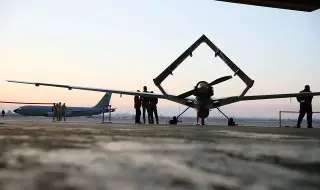
The renewed use of Turkish Bayraktar TB2 strike unmanned aerial vehicles (UAVs) by the Armed Forces of Ukraine deep in the Russian operational rear areas is an indicator of the degradation of Russian air defense (air defense) capabilities. Successful strikes with them can be seen as an element of the Ukrainian army's campaign to suppress and destroy enemy air defenses (SEAD/DEAD).
The Bayraktar TB2 gained wide popularity in the initial stage of the war (February-March 2022), when they demonstrated effectiveness against Russian armored vehicles, supply columns, and concentrations of troops during the offensive towards Kiev. The inability of the Russian Federation to provide a reliable air shield for its advancing formations then faced them with serious losses from Turkish drones.
With the formation of a relatively stable front line and the construction of a multi-layered Russian air defense system, the effectiveness of the TB2 in the immediate combat zone decreased significantly, with the platforms becoming an easy target for the system.
The Turkish drone manufacturer set out plans in 2022 to establish a production plant in Ukraine, with construction scheduled to begin in early 2024 and be completed by August 2025. The plant has been the subject of frequent Russian air strikes, with 4 attacks reported in the last 6 months. It is not in operation, but most of the production facilities are prepared.
The attacks clearly outline gaps in the integrated air defense of the Russian Federation. They can also be seen as an indicator of the effectiveness of Ukrainian actions directed against early warning systems, radar stations and elements of the Russian air defense shield. Strikes against such targets have already been documented in Crimea, Zaporizhia region and even on Russian territory, with radar complexes being the main priority.
If the trend of degradation of Russian airspace control capabilities in southern Ukraine continues, this could create favorable opportunities for Ukrainian strikes with cruise missiles of its own production, as well as for expanding the spectrum of air operations. These plans were also hinted at by Ukrainian representatives.
„Ukrainian forces are actively working on Russian military facilities in Crimea. This activity is also aimed at exhausting the enemy's air defense. Thus, our units of the Armed Forces of Ukraine are paving the way for our other means of inflicting fire damage. I will not talk about the „Flamingo“ and „Neptune“ missiles now, but the path is being paved "That's why I think that soon, of course, not tomorrow or the day after tomorrow, but over time, Ukrainian aircraft may appear in the sky over Crimea, which will strike at ground targets," said Serhiy Bratchuk, spokesman for the Ukrainian Volunteer Army (UVA).
In this regard, it is also important to note the development of the Ukrainian FP-5 "Flamingo" cruise missiles. This is the first heavy cruise missile created entirely in Ukraine, with a range of about 3,000 kilometers and a large combat load of over 1,000 kilograms. Weighing about 6 tons and using an AI-25TL turbojet engine, "Flamingo" combines a long range and a maximum speed of up to about 950 km/h. The missile is intended for mass production and provides significantly greater destructive power compared to previous Ukrainian long-range weapons, and in its first combat use it hit objects on FSB in Northern Crimea.
In addition, the Ukrainian Air Force will soon have a large number of ERAM (Extended-Range Attack Munition) missiles (up to 3,350 units), under a program funded by Europe and approved by the United States. ERAM is an air-to-surface cruise missile, produced in various variants, one of which has a range of about 460 km and is capable of destroying well-protected military targets such as ammunition depots, command posts and logistics hubs. Despite the limitations and the need for permission to strike on Russian territory, ERAM missiles will significantly expand the Ukrainian Air Force's deep strike capabilities. There is also the possibility of installing up to 12 such missiles on a single F-16 fighter, which would allow for the simultaneous launch of a large number of missiles in massive attacks.
Authors: Georgi Vasilev and Stanislav Ivanov