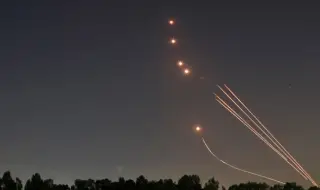
After NATO jets intercepted drones in Polish airspace the previous night, the alliance tried to reassure its citizens that everything went as it should.
The incident was the most serious escalation of the war in Ukraine yet for NATO, whose planes collided with drones it claims came from Russia, Reuters reported.
"Our air defense systems were activated and successfully ensured the protection of NATO territory for which they were intended," said NATO Secretary General Mark Rutte.
"NATO's rapid response of Russian drones that violated Polish airspace at night is firm. "Bravo to the responders, this is how we work!" exclaimed Admiral Giuseppe Cavo Dragone, head of the Alliance's military committee.
HOW PREPARED IS NATO FOR DRONES?
However, analysts say the incident has raised serious questions for NATO about whether foreign drones should be allowed to enter its airspace at all and how well equipped the Alliance is to deal with such threats.
"This is a very good illustration that we need to be not only vigilant, but also more decisive in our actions," stressed Peter Bátor, former Slovak ambassador to NATO.
Although the reason for the incursion remains unclear, Bátor said it was "unacceptable" that the drones were able to enter NATO airspace, as it meant that the Alliance was responding of a threat, rather than deterring it as intended.
He asked whether it would be acceptable for foreign troops to enter NATO territory, as drones do. "There is no big difference between drones and troops," Bator noted.
He suggested that NATO could reach an agreement with Ukraine to allow it to shoot down Russian drones that pose a threat to the alliance on its territory before they enter its airspace.
However, NATO operates by consensus and there is little sign that such a move would receive support from all allies, some of whom are extremely wary of being drawn directly into the war.
In previous, smaller incursions by drones or debris from the war in Ukraine - in several countries, such as Poland, Latvia and Romania - the alliance has chosen not to respond militarily.
Moscow has denied responsibility for the latest incident, with a senior diplomat in Poland saying that the drones came from the direction of Ukraine. The Russian Defense Ministry said its drones carried out a massive attack on military facilities in western Ukraine, but that there were no plans to hit targets in Poland.
A Polish military spokesman said that most of the drones were of the "Gerbera" type. It is an "extremely cheap fixed-wing unmanned aerial vehicle made of polystyrene with a range of a few hundred kilometers," explained researcher Fabian Hintz of the International Institute for Strategic Studies.
According to officials, the NATO response included expensive weapons such as F-35 and F-16 fighter jets, Mi-24, Mi-17 and Black Hawk helicopters, and Patriot air defense systems.
The response included forces from Poland, the Netherlands, Italy and Germany.
This multinational arsenal was apparently sufficient to deal with about 19 drones, some of which were shot down after Polish authorities deemed them a threat.
The war in Ukraine, however, is the scene of extremely intense drone warfare, often involving attacks by hundreds of drones. simultaneously.
This is a challenge for some of NATO's more traditional air defense systems, designed to defend against missiles and manned aircraft.
"Western air defense systems were not designed with affordable unmanned aerial systems in mind," explained Hintz.
"Taking them down with manned aircraft, such as fighter jets and helicopters, is possible, as has been proven, but requires a high tempo of operations if the threat is continuous".
Phillips P. O'Brien, professor of strategic studies at the University of "St. Andrews" in Scotland, said the drone incursion was a "small sting compared to what Ukraine experiences every night".
"They should have been identified as potential threats much earlier and defensive preparations put in place well in advance," he noted.
"This should have been child's play for NATO," O'Brien said. "God help them if they face 600 drones and missiles in one night".
When asked whether NATO should better defend itself against drones, Secretary General Rutte replied: "Of course, we must always be confident that we are one step ahead. But I think last night we showed that we are capable of protecting every inch of NATO territory".