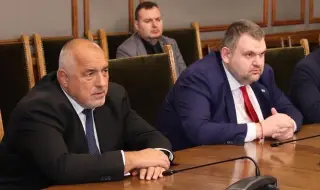
The main "D" and Borisov against the "harmful" Radev in the fight for the prosecutor's office. Another episode. Or a game of chess – another. After the Supreme Court of Cassation decided, because the court decides, and does not indicate, give a recommendation, express an opinion, express an opinion, that Bulgaria does not have a chief prosecutor, we have a rather interesting situation that many lawyers define as a constitutional crisis.
Since there is no official chief prosecutor, a new selection procedure will have to be reached somehow. The Supreme Judicial Council may resume the old one, which was stopped because only Sarafov was a candidate (ed. – although initially he did not want to become chief prosecutor, and then he asked. Now, respectively, he does not want to give up the post…), and it may also start a new one (ed. - this will most likely happen, because this will buy time until a good candidate "emerges" on the horizon)
And all this is playing out as if a new chess game has begun, which - for better or worse - must end with a presidential decree. After Rumen Radev signs, we may have a new prosecutor general. The names of Delyan Peevski, Boyko Borisov, Borislav Sarafov - acting prosecutor general, invariably surface when talking about the real architecture of power in Bulgaria.
On the other side - although alone, although at the end of his term, is President Rumen Radev. The head of state - a figure with increasingly curtailed powers, is definitely positioning himself as an always convenient "enemy". Although formally Peevski, Borisov and Sarafov occupy different institutional roles, these figures shape the strategic fields on which the most important political and institutional processes are played out.
The political situation now increasingly resembles a chess game with long-standing players, rather than a democratic match with clear rules. “Democratic“ Peevski, “democratic“ Borisov, “democratic“ Sarafov – more and more democracy missing from the Constitution.
Peevski - a figure who for a long time acted from the background, because the foreground was Ahmed Dogan, now openly occupies a leading political position. Borisov - a leader with a long managerial experience, continues to have weight, even when he is not formally in power. President Radev is positioned as a counterpoint to the status quo, but he also operates within a complex institutional balance.
Against this background, the prosecutor's office and the prosecutor general are not just participants - they are an instrument that can change the direction of political processes. Borislav Sarafov, in his role as a key player in the system, stands at the center of the tension between institutional independence and political influences.
The big question before society is not only who is playing against whom, but who is actually pulling the strings. Because while political leaders exchange accusations and public messages, decisions are made behind the scenes — through agreements, balances of influence and silent compromises. While the prosecutor's office remains without real accountability and its independence is in doubt, this chess game can hardly end with a checkmate in favor of the public interest. Is Bulgaria at a crossroads… Maybe.
Will Bulgaria continue the model of concentrated power in a few hands, or will it begin a painful but necessary process of real institutional change!? The question is not rhetorical, but time-consuming, because Bulgaria will have it after Peevski, Borisov and Sarafov. The question is how many more chess games will society observe before it pushes the pieces positioned on the board with one stroke.
Link to main version
Oct 10, 2025 13:27 511
The main D and Borisov against the "harmful Radev - and the fight for the prosecutor's office has begun
The political chessboard is being arranged - between the state prosecution, the government and the shadows behind it
Снимка: БГНЕС
ФАКТИ публикува мнения с широк спектър от гледни точки, за да насърчава конструктивни дебати.