Author: Martin Atanasov
The evening of November 26 brought to Sofia a commotion that our capital had forgotten in recent years. Tens of thousands of citizens filled the space around the parliament and the "triangle of power" in protest against the proposed budget for 2026 - an act born simultaneously from anxiety, fatigue and long-accumulated dissatisfaction and tension.
Organized by the PP-DB, opposition political formations and civic groups, the protest turned into one of the largest demonstrations of public discontent in recent years. According to rough estimates (and the opinion of ChatGPT, which I sought), between 20-25 thousand joined the demonstration, which grew into a night blockade until after midnight.
But unlike other protests organized since 2023, this one had a different character. The air was saturated not only with anger and anxiety, but with something else - a feeling of awakening.
The protest was different
This year alone, Bulgaria has seen quite a few demonstrations - against the judicial system and the arrest of the mayor of Varna, about the salaries of young doctors, against the educational reform and the adoption of the euro. But last night's protest stood out for two reasons that overturned the usual logic of civic mobilization.
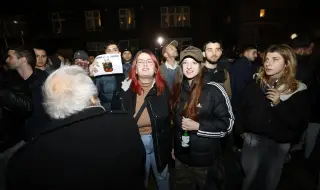
First - mostly young people took to the streets - from 16-17 years old to around 30 years old. Many came after work or school, others directly from universities. They were the overwhelming majority, a visible critical mass that changed the very face of the protest. Young people with different views and different life trajectories, united by the feeling that our future in this country is disappearing.
This generation - born after 2000 - rarely engages in public protests in our country en masse. But tonight was different. It was our night! And I, as a representative of this young generation (editor's note: I was born in 2007), can say that the presence of so many young people was not accidental. It was a sign that the internal discontent of Gen Z - usually quiet, on social networks - is starting to turn into action.
And the emotion in the square was not just denial and anger - it was hope. Hope that the country can break out of the vicious circle of distrust, improvised solutions and political indifference to the people. Hope that this time did not come from the number of people themselves, but from their profile – from the young, as the bearer of a new type of political culture.
And for the first time in years, the same feeling that Bulgaria remembers from its cyclical moments of civic awakening: 1997, 2013, 2020 reappeared. A feeling that another generation was rethinking its role.
But why did Gen Z take to the streets?
The young did not come out because the budget directly affects them. The changes in insurance and tax burdens will hit other groups mostly – their parents, their employers and businesses. Neither social measures nor fiscal decisions can explain their motivation.
And yet they were there. Generation Z is not the most vocal, but it is the most informed in the digital environment. It consumes news and public processes through its phone - via Instagram, TikTok, X, Threads. And in this flow of information that appears in their feed, young people create a kind of “civic sensitivity“ to injustice, corruption and arbitrariness.
And this was one of the hidden weapons of this protest - it also spread online. And not just on Facebook, as usual - it was on Gen Z social networks - through the pages they follow, through influencers and their friends, young people found out about the protest. And they went out.
They took to the streets because in recent years this civic sensitivity of young people has been building up tension. And although the budget was the formal reason for the protest, the real reasons are deeper: a sense of institutional disintegration, aggressive state actions (and inactions), scandals without consequences, arrests without a clear reason, legislative proposals that undermine freedom of speech or reforms without purpose and direction.
And yes, the Gen Z generation is not specifically affected by each of these measures, but we are affected by the general environment they create. The environment in which we will live, build a career, business and family. An environment that is toxic. It is also the reason why the supposedly “apathetic” Gen Z has started to wake up.
It depends on us
The protest of November 26 showed something important: young people came out not just out of anger, but out of hope that change is still possible. And that it starts with us. For many, this may have been just another protest. But for us (Gen Z) it was something more - proof that there are active young people in Bulgaria. For some of us, this was their first protest, out of probably many, but it was a charge because it showed that young people have a voice and that this voice can carry weight.
Young people do not want to “save the state“ – we simply want the state not to prevent us from living in this country. And when this seems impossible, our reaction is natural.
Real change will not come overnight. The road is long and difficult, but when we are together, fear recedes and hope becomes real - if we continue to protest, speak up, insist. If we do not allow apathy to hold us back. It is up to us whether this spark will die out or become a light that will lead everyone forward - not just the young, but the entire society. There is hope. It is up to us to protect it.