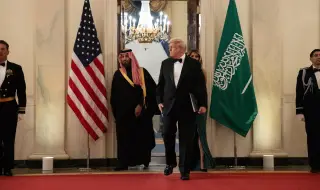
It is difficult to find a single bad word said by US President Donald Trump about "strongmen" and authoritarian leaders in the Middle East. He called Saudi Crown Prince Mohammed bin Salman "fantastic" and "brilliant". Trump apparently believes that what Bin Salman has done on human rights is simply "incredible". But this year Saudi Arabia has executed more than 240 people - often without trial or conviction, human rights groups say.
"He's a tough guy, but he's my friend"
As for Turkish President Recep Tayyip Erdogan, the US ambassador to Turkey recently described Trump's relationship with the increasingly autocratic Turkish leader as a “male friendship“: “He's a tough guy, but he's my friend“, Trump said during a meeting with Erdogan, even though shortly before that the Turkish president had been mentioned in the international media for the arrest of opposition politicians.
In a meeting with Erdogan in October, Trump said: “He's a tough guy, but he's my friend“, and the Turkish president had just been criticized by the international media for the way he dealt with his political opponents. opponents. “I don’t know why I like tough people more than soft and easy people,” Trump said recently.
A New Approach to Authoritarian Regimes in the Middle East
Previous U.S. administrations have tended to tie military deals and aid to the Middle East to respect for human rights and democratic policies – or at least to express support for those ideals. But according to this month’s updated version of the U.S. National Security Strategy, that is no longer the case.
The 2022 version, prepared for former President Joe Biden, said that in the Middle East the United States would “support and strengthen partnerships with countries that adhere to the rules-based international order” and will “demand accountability for human rights abuses“.
The new version of the Trump administration, published in early December, makes no mention of human rights and only mentions a single place of the “rules-based international order“. Regarding the Middle East, it simply says that America should stop “putting pressure on these nations – especially the Gulf monarchies, to abandon their traditions and historical forms of government“.
The same document does not treat European “forms of government“ with the same favor. The Trump administration may intend to stop “put pressure“ on the Middle East, but in Europe it clearly plans to engage in what the European Council on Foreign Relations last week described as “a culture war“ - for example by supporting right-wing anti-European political parties.
Why does Trump prefer Arab monarchs to EU leaders?
“Donald Trump's personalized decision-making style and authoritarian instincts make him a much more natural “strong leader“ than conventional democratically elected leaders“, says Christian Coates Ulrichsen, a Middle East researcher at the Baker Institute for Public Policy at Rice University.
“Trump's affinity for leaders in the Middle East, and especially in the Persian Gulf, may be rooted in certain similarities in decision-making styles, as well as in the commercial basis of the relationships they build“, he told DW. Gulf leaders also have the advantage of not falling into the camp of traditional US allies or adversaries, Ulrichsen adds, but rather being close partners, something like.
Andreas Krieg, a security expert at King’s College London, wrote the following before Trump visited the Gulf in May of this year: “Trump’s transactionalism finds natural ground in the Gulf: you get what you pay for. There is no pretense of shared destiny, values or ideals. That's what the tribal monarchies of the Persian Gulf are building their relationships on.
Qatar gave Trump a $400 million plane, and the United Arab Emirates and Saudi Arabia have made generous promises to invest hundreds of billions in the American economy.
Trump seems to like the idea of being king
Trump also probably appreciates the lack of constraints on political action that authoritarian leaders in the Middle East have, Coates Ulrichsen adds - something "that Trump himself is striving to achieve - especially now, in his second term."
Saudi Arabia, the UAE and Qatar are ruled by royal families who formulate their own laws, do not tolerate political dissent and - because they are not democracies - do not depend on the approval of their citizens to remain in power. In February 2025, Trump called himself “king”, and on its social media accounts the White House later shared the quote with an image generated by artificial intelligence.
"Neo-royalism" is changing the international system
Professors Stacey Goddard of Wellesley College in Massachusetts and Abraham Newman of Georgetown University in Washington wrote an article for the journal “International Organization“ in which they examine Trump's attachment to “strongmen” from the Middle East as part of an emerging system they call “neoroyalism“.
Scholars define it as “an international system structured by a small group of hyper-elites who exploit contemporary economic and military interdependencies to extract material and image benefits for themselves”. Trump clearly views certain leaders as possessing something akin to monarchical sovereignty and has accordingly prioritized his relations with them.
According to the same authors, other countries have also moved towards a system dominated by elites - Turkey, India, Hungary, China and Russia. But now that the United States - with its economic and military power - is also moving in this direction, the idea is spreading, as other leaders, including in Europe, are forced to play the same game, Newman and Goddard write. “All of them - From Erdogan to the rulers of Saudi Arabia to the United Arab Emirates and Qatar, they provide Trump with this legitimacy: he can say to himself, "What I'm doing is normal," says political scientist Abraham Newman.
Author: Catherine Scheer