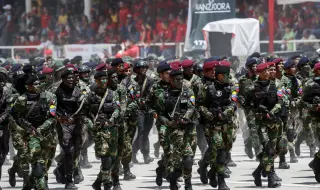
In Venezuela, the actions of the US armada in the Caribbean are causing increasing concern: the targets of warships are now not only boats suspected of carrying drugs, but also oil tankers. But while experts' assessments of Venezuela's role in the drug trade vary, the key importance of oil exports is clear. Venezuela has the largest known oil reserves in the world - probably over 300 billion barrels.
These underground treasures are likely to play a role in the strategic intentions of US President Donald Trump, for whom oil is a key raw material. Venezuela's resources are also key to President Nicolas Maduro's foreign policy. However, the escalation of the conflict in the country cannot be explained only by oil - other interests also play a role. Along with the United States, the other two major powers - China and Russia - also pursue their own goals in the region.
What are China's geopolitical goals in Venezuela?
Venezuelan oil accounts for only four percent of China's imports, but the trend is growing: according to data from the “Reuters“ agency, higher figures are expected for December - over 600,000 barrels per day, which means the majority of Venezuela's daily production. The country is an important source of oil for China, mainly because it can strengthen its energy independence in the global race for raw materials. This works especially well with Venezuelan oil of the “Merey“ variety, which is sanctioned by Western countries.
China, in turn, pays Venezuela back with money, including in the form of loans. According to various estimates, Caracas owes between 60 and 70 billion US dollars to Beijing.
Chinese equipment is also being sold in Venezuela: weapons, as well as telecommunications infrastructure, largely developed with Chinese parts. In September, Maduro presented a new smartphone from the Huawei brand at a press conference in Caracas - “the best phone in the world”, a gift from Chinese President Xi Jinping, which, according to him, could not be hacked by American secret services.
Venezuelan authoritarian-nationalist socialism is close to Chinese state ideology. And since Beijing has recently verbally condemned actions such as the recent seizure of oil tankers by the US, it can also present itself as an ally. This is beneficial to China, as Washington is busy with closer geographical issues.
For ten years, successive US presidents have been paying increasing attention to the Indo-Pacific region - where China is also striving for a dominant role and is increasingly aggressively asserting its claims to Taiwan. That is why China is interested in the US focusing on Venezuela or Cuba.
What interests does Russia pursue in Venezuela?
Moscow would also have an interest in exerting influence through its allies in Latin America and thus weakening US dominance. In 2001, Putin first received then-Venezuelan President Hugo Chavez. Since then, Russia has become the largest supplier of arms to Venezuela. During Putin's war in Georgia, Chavez helped Venezuela recognize the breakaway regions of South Ossetia and Abkhazia as independent (along with Nicaragua and Nauru).
Maduro, for his part, has made efforts since Chavez to continue close relations with Moscow. When his power was under immediate threat in 2019 and then-speaker of the parliament Juan Guaido declared himself the winner of the elections and interim head of state, he received immediate support from the United States: Trump wanted to get rid of Maduro during his first term. But then Russia sent two warplanes with soldiers and weapons. "Moscow basically saved Maduro," said Vladimir Ruvinsky, a political scientist at Columbia University in New York, in a recent interview with DW. "For the first time since the Cuban Missile Crisis, the United States was forced to discuss the situation in Latin America directly with Russia." In the current confrontation, however, Ruvinsky does not expect such decisive Russian support for Maduro - for now, the Kremlin is limiting itself to verbal support.
What does the US want?
In mid-December, in a post on his social network Truth Social, Trump demanded that Venezuela return "all the oil, land and other wealth that it previously stole from us". He may be referring, for example, to the seizures within the framework of the nationalization of the Venezuelan oil industry in 2007, for which not all American concerns received compensation. Only "Chevron" continues to be active in the country, thanks to extraordinary agreements. However, for American concerns, oil production in neighboring Guyana, whose border region Venezuela claims, seems much more profitable. Regarding US oil interests, there are simultaneously two arguments in favor of the forced removal of Maduro.
During his first term, Trump significantly expanded the sanctions imposed by his predecessor Barack Obama and has already tried to overthrow Maduro once. His then-national security adviser, John Bolton, described Venezuela, along with Cuba and Nicaragua, as the "triangle of terror". Bolton was fired by Trump after his support for Juan Guaido failed to produce results. Now Trump is pursuing the goal of regime change in Venezuela more determinedly than ever.
Author: David El