Author: Alexander Detev
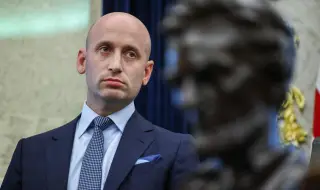
He was only 31 years old when he began writing speeches for Donald Trump during his candidacy for US president. Today, Stephen Miller is one of the key advisors to the American president.
And if until recently it was believed that Miller seriously influenced the anti-immigration policies of the White House, his latest statements suggest that Washington's foreign policy decisions also completely overlap with his views. Views that are indicative of the entire ideology of the new administration in Washington.
Who is Stephen Miller?
While still a student at "Duke" University in California, Miller has made no secret of his far-right views or his dislike of multiculturalism. After he became part of the first Trump administration, leaked correspondence from him revealed that he had been willing to share and forward articles from publications that promoted white supremacy and other xenophobic views.
According to sources at "Vanity Fair", when the first Trump administration began separating families at the border with Mexico, including parents from their children, Miller "loved watching the footage". These revelations by the American publication are reminiscent of another belief of the far-right, some of which are associated with the MAGA movement and Donald Trump - that empathy is the big problem of today's world.
In early 2025, Elon Musk told Joe Rogan that "empathy is the fundamental weakness of Western civilization". And in her book "Toxic Empathy: How Progressives Exploit Christian Charity", right-wing commentator Ali Beth Stuckey argues that Democrats exploit empathy so that it becomes empathy for women but not for the fetus when it comes to abortions, or for migrants but not for the local population when it comes to accepting foreigners.
Thus, Trump's doctrine calls into question the protection of human rights, perceived as an invariable part of the democratic world. The American president has not been shy about attacking people based on their origin, gender, political beliefs, religion or sexual orientation. And pitting the rights of some against those of others.
"A world ruled by force"
Trump's speeches have become a mirror of the ideology that Miller and those around him profess. And in recent days, Miller's own statements seem to be a mirror of the foreign policy of the Trump administration. In them, both international law and alliances, as well as the inviolability of human rights, are relative. The only grounds that dictate US foreign policy are two - interest and the position of the strong.
"We live in a world where you can talk all you want about international courtesies and all that, but we live in a world, in the real world (…), that is ruled by force, that is ruled by might, that is ruled by power", Miller said in an interview with CNN after the US intervention in Venezuela.
"These are the iron laws of the world since the beginning of time", he added. Following this maxim, aggression is clearly not only directed at ideological opponents like Venezuela - it can also be directed at NATO allies like Greenland, as long as the US has an interest in it.
In Trump's public statements, human rights are not even used as a pretext for the intervention in Caracas. On the contrary: the old regime will remain in power there if it meets Washington's expectations, and the main word coming out of the mouth of the American president is one - oil.
Because the real world is ruled by force, as Miller says. And solidarity with the oppressed people of Venezuela is not even on the table, because empathy, as has already become clear, is a problem in itself.
It's all ideology
Trump is a businessman, and that is why some of his foreign policy moves puzzle observers - for example, the introduction of high tariffs and the rejection of long-standing traditional allies of the United States. According to historian Brett Devereux, Trump's moves, which seem illogical from the point of view of real politics, must be explained in another way - ideologically.
The ideology of Trump and his associates is personalistic, authoritarian, and post-liberal, he writes in an article for "Foreign Affairs". At the same time, it is hostile to globalization. The desire for autonomy is key to most authoritarian systems, he emphasizes, even when it is economically unjustified. Hitler also pursued such a policy, although economically it created serious problems for Nazi Germany. The Soviet Union also tried to pursue an autonomous economic policy in the 1920s and 1930s. Such efforts can serve domestic purposes, as more autonomous economies are usually poorer and less productive - and are under greater control by their authoritarian leaders.
Thus, disregard for international rules and acts of aggression against another country without coordination with allies fit into Trump's ideology. Still, we know that he doesn't like the international community and its rules as they are. It's no coincidence that he has now pulled the US out of 66 more international organizations. And most of the people Trump has surrounded himself with, including Stephen Miller, fully share his views.