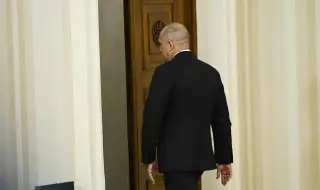
Veselin Stoynev's comment:
President Radev has opened a new page in Bulgarian politics. His departure from the presidency to the party arena will give impetus to electoral activity and will seriously reformat the next parliament, opening up the possibility of a new governing configuration, which without him seems much less likely.
However, the positioning of Rumen Radev's formation on the parliamentary arena is yet to come. In his farewell presidential speech, he did not give any hints about what his own political project will be. He only tried to include or appropriate under his general's cloak all those who are dissatisfied and have fought against the oligarchic status quo - from the protests in 2020 and 2025, from students to Bulgarians abroad. He did not outline any ideological and political benchmarks other than the blanket request for a “new social contract“ and “battle for the fatherland“.
In the field of party politics, however, the presidential universality, even in a populist version, is subject to numerous limitations on political self-determination from which he cannot escape. The key questions that Radev will have to answer will more or less shrink his large basket.
Is the euro good?
The president reminded in his presidential speech of the illegal referendum on the euro that he had rejected. But in any case, it is already a fact and Radev will now have to answer whether he considers its introduction successful and whether it is still positive for the country, even if he considered it premature. This issue cannot be swept under the rug if he claims to be the leader of a leading political force in a country that is a member of the eurozone. Because at the very least, this will raise doubts about whether he is harboring ideas to take us out of the eurozone or at least will continue to impotently and stupidly try to sabotage it, just to show how right he was and what a defender of direct democracy he is. But even if he were right - and he was not - with such grumbling he would resemble a selfish politician, focused on his navel and unable to look ahead.
Whose Greenland is it?
If in the pre-election debate of the runoff before his second presidential term Radev had to answer the question “Whose Crimea is it?“, now with no less divisive force he must answer “Whose Greenland is it?“. Because this is a key issue for his position towards the EU and the US, a key benchmark of Bulgaria's geopolitical orientation in the rapidly changing global environment, on which both the country's security and economic future depend. Ultimately, the question "Whose Greenland is it?" comes down to the question "With the EU or with Trump?", which could mean in its second part also with Trump-Putin.
Will there be a new alliance?
Radev accused the PP-DB, without naming them, of erasing the difference between corrupt people and those fighting corruption. This is understandable at least because this alliance with GERB was also against him, as a pro-Russian president during Russia's invasion of Ukraine and against his sole rule through official cabinets. However, if he is really fighting against the vicious oligarchic model of government, he will need partners. And the biggest ones are PP-DB, some of which he called charlatans until recently. Both he and they will invariably be asked every day until the elections by journalists and citizens - will you form a coalition?
What else besides anti-Peevski and Borisov?
Radev will have to offer a broader platform besides the anti-corruption one, which will inevitably position him on the left-right axis. Will he be for maintaining tax and social security rates at current levels or will he be for a more distributive state? Will he, in addition to a retributive one, also seek social justice with liberal-progressive or left-social policies? Will he be for a civil and secular principle in education or for imposing religious education in schools? Like any serious political formation, his will have to offer a comprehensive pre-election platform. The question is whether it will have enough distinguishable distinctions, or will it be based on populist omnivory with beautiful general messages that will appeal to the widest range of people.
Who will be on the lists and in the management echelon?
Like any new formation, the president will face a personnel problem - many careerists and many untested people can undermine the new formation, or depersonalize it with a deficit of good personnel density. Unconvincing or compromised individuals can even melt the initial hopes for it. Radev's advantage is that with two months left until the elections, eyes will be focused more on himself than on his people, and the deficits will not weigh much at the beginning. Like any good soldier, however, he knows well that a war is not won by winning the battle, but by winning the peace, i.e. with the ability to make victory a lasting success. And this cannot happen without a broad and competent, corruption-proof and scandal-free personnel bank.
Broad center
Rumen Radev's formation will most likely seek to take broad centrist positions, attracting voters from almost all parties and mainly from those who have not voted so far. However, his direct electoral donors will be “Vazrazhdane“, ITN, BSP and “Velichy“, although most of those threatened welcomed him on the party field. “Vazrazhdane“ entered into a sharp confrontation with him, thus pushing itself into the most radical periphery and ceding to him the more moderate Russophiles and Eurosceptics – unlike its sister Western European parties, which remained in sovereignist positions during Trump's attack on Europe.
PP-DB is also in a difficult position, whose prospects for more serious electoral growth after the protests already seem to be more severe with the appearance of the “fresh” competitor on the anti-corruption front. At the same time, an electorally powerful formation of Radev both turns out to be the PP-DB's most reliable partner in the battle against the conquered state, and puts it under pressure and in an explanatory mode because of its pro-Russian orientation – anti-corruption and Europe, future collaboration with Radev may not lead to their direct coalition participation in power, unless, for example, he signs some kind of “eastern cordon“.
The most advantageous position seems to be that of GERB, which will probably consolidate its forces in strategic defense without serious electoral loss, with the possibility of fierce attacks on a more convenient enemy than PP-DB in the person of Radev, vulnerable with Putin, the euro and “Botas“.