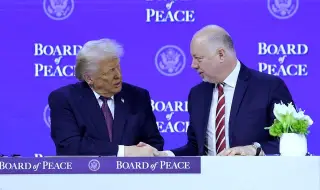
Zhelyazkov joined Trump, Orban and company and included Bulgaria in the Peace Council. Sofia failed to declare support for Denmark and Greenland, but did not fail to bow its head without complaint. Shameful, believes Alexander Detev.
Since returning to the White House, Donald Trump has been driving through the international order like a dump truck - and until now the world seemed to be uncomplainingly adapting to his whims and understandings. Until he asked for Greenland. Washington's appetites for the island put NATO partners in crisis mode and they clearly demonstrated that everything has limits, even with regard to the so-called leader of the free world. Because it is one thing for Europe to smoothly take on the burden of its defense and support for Ukraine, it is another to be squeezed in a vice by two powers - the USA and Russia, which, in addition to serious ideological differences, also have territorial claims to it.
The principles that ensured 80 years of peace
If we are together, we will get a place at the table, if we are not - we will end up on the menu, said Canadian Prime Minister Mark Carney in Davos, and his speech quickly became a sensation. Emmanuel Macron called for stopping the "transition to a world without rules", in which "international law has been trampled". His sunglasses, which he wears due to a medical condition, only emphasized how cool it is to defend the principles and foundations that have ensured the 80 years of peace that the West has enjoyed until recently.
Trump seemed to hit a snag for the first time in his attempt to take the world back years - to the times of spheres of influence and constant conflicts that rearrange the chessboard geographically, economically and politically. He himself tamed his tone - yes, he wants Greenland; and yes, he will be angry if they don't give it to him; but he will not attack, and he will not impose punitive tariffs.
The second blow follows - the Peace Council. That "elite club", for which Trump announced that participation in it would cost 1 billion.
We will not participate if Putin is invited, Britain was categorical. All European countries followed her. Even China stated that the center of the international system is the UN and does not see the role of such a council. However, autocrats like Alexander Lukashenko, Mohammed Bin Salman, Recep Erdogan, who are notorious for repressing the opposition in their countries, interfering in foreign countries, and destroying precisely those democratic rights and freedoms that the United States until recently embodied, have joined him. There is also Benjamin Netanyahu, who has been indicted by the International Criminal Court in The Hague. And he is not for too much peace.
Europe has no place on this council. Europe has a historic chance to become the haven of democracy, progressive policies, and diversity, which in recent decades have allowed the United States to establish itself as the most influential and developed power in the world. These same principles are incompatible with the already listed members of the council. They are also incompatible with shaking hands with Vladimir Putin, whose hands are stained with blood. They are compatible only with his most loyal ally in Europe - Viktor Orbán. Hungary is the only EU country that has so far declared that it will join the Peace Council. However, another one has also surprisingly backed down…
Illustrative end to Zhelyazkov's premiership
Imagine resigning after protests against your government, supported by over 70% of the population. And in your last days as a resigning prime minister, making a geopolitical declaration on behalf of your country that turns you into a pariah for your closest allies. Surely you have very strong principles and long-held positions that do not allow you to do otherwise? No, that is not it, especially if your name is Rosen Zhelyazkov.
Mr. Zhelyazkov lined up next to Donald Trump, Viktor Orban and company and included Bulgaria in the Peace Council, without explaining to the nation why and how. Bulgaria failed to declare support for Denmark and Greenland, but did not fail to bow its head without complaint to the next strongman of the day. Without a position, without a backbone, without self-confidence. But what can we expect from a politician who allegedly does not like to be called "Mr. Prime Minister" in the presence of Boyko Borisov? An illustrative end to the premiership of Rosen Zhelyazkov. Also illustrative of Bulgarian foreign policy in recent years, which at one point was led by the acting prime minister, an accountant by profession, since there was no one else to lead it. A country with such low self-confidence that it does not even consider it important to include international challenges and conflicts in its political, public and media agenda. While other countries, similar in population and territory, but far from such a key place as location, become catalysts of world processes. Provincialism is not a matter of birthplace and residence - it is a state of mind.
By the way, does Bulgaria now have a foreign minister? Oh, yes, there was... A certain Georg.
This text expresses the opinion of the author and may not coincide with the positions of the Bulgarian editorial office and the State News Agency as a whole.