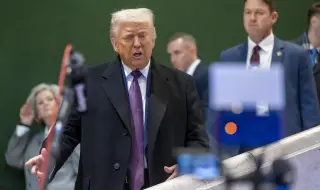
Every political system reaches its limit when it replaces sovereignty with procedures. This year's Davos forum clearly showed the end of the illusion that international order can be constructed and maintained by supranational institutions acting as an autonomous source of rules and legitimacy.
The traditional rostrum of neoliberal globalism this time became a megaphone through which the United States, through President Donald Trump, articulated a different reality: the constitution of geopolitics is restoring its operation.
It was significant that even representatives of the recent globalist consensus, including Canadian Prime Minister Carney, formulated a realistic vision of international processes and proposed approaches that are consistent not with normative illusions but with geopolitical reality.
The concept of "constitution of geopolitics" used here is meta-legal. It is not based on objective law, materialized in rules and procedures, much less on supranational agreements. The constitution of geopolitics is the functional framework that defines three key dimensions of the international system: the distribution of political power among states; the way in which power and law are combined; and the boundaries within which conflicts can be managed. Its foundations are sovereign decision, sovereign action, and the material power and ability through them to construct the international environment. Like the national legal constitution, this unwritten but factual framework structures the struggle for influence and power in global politics.
The supranational project of neoliberal globalism attempted to suspend this very constitution by building institutions that functioned as autonomous legislators and sources of both international and domestic political order. They were expected not only to regulate international processes and multilateral cooperation, but also to impose universal value and normative models that predetermined the decisions of states on key issues of their sovereign agenda - economy, security, ecology, cultural identity. The result of this project, however, was a systemic vacuum - both at the international and national levels. Supranational institutions gradually became detached from the concrete political, historical and cultural realities of states, which deprived them of sustainability, effectiveness and legitimacy. From being executors of delegated powers, they began to assume the role of de facto sovereigns, carrying out deep interference in national statehood, far beyond the competences granted to them under international treaties. This process was carried out through jurisdictional activism and expansive interpretations of norms that served the supranational order at the expense of the sovereign.
While the global environment was relatively stable, this ideological construction functioned. It began to disintegrate the moment stability disappeared and the neoliberal economic model lost its persuasiveness. The reason is structural: supranational rules formulated and implemented by unelected administrations cannot replace sovereign political decision. Deprived of a clearly identified bearer of ultimate responsibility, norms and institutions lose the ability to act strategically - externally this manifests itself as instability and unpredictability, and internally - as the erosion of constitutional democracy. We examined these processes in detail in the previous two articles - “The Resurrection of the Westphalian World“ and “Neo-Caesarism - from the Forum to the Colosseum“. If we use the classical concept of the political (according to Carl Schmitt), it becomes clear why all this happens: when the stake is security or existence itself, it is not the procedure that governs, but the one who is ready to pay the price of action.
It is in this context that the current actions of the United States should be viewed - including the imposition of decisions and the limitation of ineffective supranational structures - with the aim of restoring the strategic balance that in recent years has been eroded in favor of China and Russia by the neoliberal model through policies of deindustrialization, climate panic, open doors for indiscriminate migration, gender extremism and aggressive atheism. After the Cold War, the belief spread widely that economic liberalization inevitably leads to political. Societies were reduced to economic mechanisms, and material interest to the universal engine of freedom. However, historical experience refutes this logic. States are not markets, but historical communities - with memory, geography, cultural logic, national mythology, social fears and identities.
When the global order is perceived as a limitation of autonomy rather than a framework for development, the answer is rarely liberalization; much more often it is the concentration of power and the pursuit of control. Therefore, the restoration of the constitution of geopolitics represents a natural return to the sovereign principle as a functional condition for order - both in the international and in the domestic political system. States remain the primary bearers of political will. They do not reject international law, but subordinate it to their own understanding of goals, security and prosperity. International alliances can be sustainable only if they stem from clearly formulated national interests and sovereign decisions.
In this sense, the constitution of geopolitics is based on several clear principles: the priority of the balance of power over universal projects; sovereignty as the main criterion of legitimacy; and supranational institutions as instruments, not as autonomous centers of power. In critical situations, it is this framework that prevails over any normative construction. The international order will be less utopian and less beautiful, but more sustainable. Small states will be faced with the choice between strategic subjectivity and dependence. Large ones will have to recognize the limits of their universalism. And constitutional democracy will have to be defended not as a historical inevitability, but as a political project that must be systematically defended against the threats of autocracy. The collapse of neoliberal globalism is neither the "end of history" nor its "return". History has never gone away - an attempt was made to suspend its fundamental law. Today, this law is coming back into force.