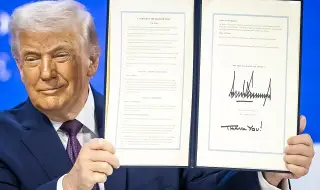
President Donald Trump is giving and taking. Offended by Canadian Prime Minister Mark Carney's increasingly aggressive stance, Trump has withdrawn his invitation to join the Peace Council. Many Western allies view the Trump-led organization, which initially focused on keeping the peace after Israel's war with Hamas, with suspicion. But it has grown into something skeptics fear could rival the United Nations.
At an appearance at the World Economic Forum, Trump spoke of imposing tariffs on Switzerland, which he eventually reduced. He said the country's leader had "got on my nerves" during a phone call. Before he lifted sweeping tariffs on a number of European countries, Trump pressed Denmark to "say yes" to the US's push to take control of Greenland. "And we would be very grateful. Or you can say - no and we will remember that," Trump said, threatening NATO.
For decades, Trump has shown no affinity for pleasantries in his public life. But last week's turbulent events stood out even by his standards because they clearly demonstrated his determination to dismantle the rules-based order that has guided US foreign policy, and more broadly, much of the Western world since World War II.
The president and his supporters have dismissed this approach as ineffective, focused mostly on compromise and unresponsive to the needs of people struggling with rapid economic change. But in its place, Trump is pushing a less clear system that could prove far more unstable, guided by the whims of a single, often unpredictable leader who regularly makes it clear that personal favoritism or animosity can influence his decisions.
Returning to the United States from the World Economic Forum in Davos, Senator Lisa Murkowski, a Republican from Alaska, described the confusion among allies, saying she heard the phrase “we’re entering this new world order” “over and over.” “You could have a nasty phone call with the president and then get tariffs,” Murkowski told reporters. "I think this lack of stability and reliability is why traditionally reliable trading partners are saying to other countries, 'Hey, maybe we should talk, because I'm not sure what's going on in the United States.'"
Trump's focused approach to governance is hardly surprising, given that in 2016 he accepted his first Republican nomination for president by saying, "I'm the only one who can fix" the country's problems. But he has entered his second term with far greater confidence, delighting his supporters with his "winner-take-all" style.
Trump's former adviser, Steve Bannon, recently told The Atlantic that Trump is pursuing a "maximalist strategy" and should continue "until he meets resistance." “We haven’t met any resistance,” Bannon said. That’s certainly true in Washington, where the Republican-controlled Congress has done little to rein in Trump’s impulses. But leaders of other countries, who have spent much of Trump’s term looking for ways to work with him, are increasingly making their voices heard.
Carney quickly emerged as the leader of a movement of countries seeking ways to unite and counter the United States. “The middle powers have to act together because if you’re not at the table, you’re on the menu,” Carney said in Davos before Trump. “In a world marked by great power rivalry, the middle powers have to choose between competing for favor or coming together and pushing for a third way,” Carney continued. "We must not let the rise of hard power blind us to the fact that the power of law, integrity and rules will remain strong if we choose to exercise it together," the Canadian prime minister added.
Trump did not take kindly to these comments and responded with threats in Davos before withdrawing his invitation to the Peace Council. "Canada lives because of the United States," Trump said. "Remember that, Mark, the next time you make statements."
Carney, however, remained unfazed, calling Canada "a beacon, an example to the world at sea," as he laid out a potential model for other world leaders navigating the new era. "We can show that another time is possible, that history is not doomed to develop in the direction of authoritarianism and exclusion," he told a cabinet meeting in Quebec City.
British Prime Minister Keir Starmer on Friday sharply criticized Trump for his "offensive and frankly outrageous comments" in which he expressed doubt that if the United States asked for support from NATO, it would receive it. The president seemed to ignore the fact that the only time Article Five of the NATO Treaty, which requires all member states to help an ally in danger, was invoked was after the September 11 attacks on the United States.
Trump commented on the "Fox Business Network" non-US military personnel, saying: "You know they're going to say they sent troops to Afghanistan, or this or that, and they did, but they stayed a little bit further back, a little bit further from the front line."
Starmer noted that 457 British personnel had died and that there were servicemen who had sustained permanent disabilities. "I will never forget their courage, their bravery and their sacrifice for the country," the British prime minister added.
Denmark, which Trump called "ungrateful" for the defense of the United States during World War II, has the highest per capita casualty rate among coalition forces in Afghanistan.
Trump’s tactics have raised concerns that he will do long-term damage to the United States’ international standing and encourage some countries to rethink their alliances and deepen their ties with China. Carney traveled to China earlier this month to meet with President Xi Jinping.
"Chinese leaders have watched the American president fight with his allies, insult world leaders, and engage in bizarre antics, and thought – there’s nothing better for us," Jake Sullivan, former President Joe Biden’s national security adviser, said in an email.
The administration shows no sign of backing down. The Pentagon released a defense strategy Friday night urging allies to take charge of their own security. And on Saturday, Trump threatened to impose 100 percent tariffs on goods imported from Canada if the country continues to work on its trade deal with China.
Democratic Senator Chris Coons of Delaware, who is a member of the Foreign Relations Committee, was in Davos and, along with Murkowski, was part of a bipartisan delegation to Denmark aimed at demonstrating unity in response to Trump’s attempts to acquire Greenland. Coons told reporters Friday, recalling conversations with other leaders, that Trump has shown he only backs down when countries like China “show firmness and resilience.”
“Those who have been accommodating and negotiated in good faith, like the EU, which has not imposed retaliatory tariffs, have not seemed to earn any respect from him,” Coons said. "They can draw their own conclusions. But it seems to me that trying to find a way to accommodate his demands when the basis of his demands on Greenland is unstable... suggests a certain course of action".
Translated from English: Nikolay Velev, BTA